
A solar system has three parts that must be sized against each other: the inverter, which decides what you can run at once; the battery bank, which decides how long you can run it; and the panel array, which decides how much of it the sun pays for.
Getting one wrong makes the other two irrelevant. An enormous battery bank behind an inverter that trips when the fridge starts is a waste of money, and so is a well-matched inverter and battery with too few panels to charge them.
This guide works the sizing through in the order it should be done, with a real household as the example.
Step one: list your loads honestly
Every load has two numbers. Running watts is what it draws once it is going. Surge watts is what it demands for the first second or two while a motor gets moving. Anything with a compressor or a motor — refrigerator, water pump, air conditioner, mixer — surges to somewhere between two and six times its running figure.
The inverter must survive the surge. The battery bank must supply the running load. Confusing the two is the most common sizing error there is.
| Load | Running W | Surge W | Hours/day | Wh/day |
|---|---|---|---|---|
| LED lights × 8 | 80 | 80 | 6 | 480 |
| Ceiling fans × 4 | 300 | 450 | 10 | 3,000 |
| Refrigerator (250 L) | 150 | 750 | 8 (compressor duty) | 1,200 |
| Television | 100 | 120 | 5 | 500 |
| Wi-Fi router, chargers | 40 | 40 | 24 | 960 |
| Mixer grinder | 500 | 1,500 | 0.25 | 125 |
| Water pump (0.5 HP) | 375 | 1,900 | 0.5 | 188 |
| Total if everything ran at once | 1,545 | 4,840 | 6,453 |
Three separate numbers come out of that table, and each sizes a different component:
- 6,453 Wh/day — total daily energy. Sizes the battery bank and the panels.
- 1,545 W — theoretical maximum simultaneous running load. Sizes the inverter’s continuous rating.
- 4,840 W — theoretical maximum simultaneous surge. Almost never actually occurs.
Step two: apply diversity, but not to the surge
Nobody runs the pump, the mixer and everything else at the same instant. Applying a diversity factor of about 0.7 to the running total gives a realistic simultaneous load of roughly 1,080 W.
You cannot apply the same reasoning to surge. What matters is not every motor starting together — it is the largest surge occurring while the ordinary running load is already present. Here that is the water pump at 1,900 W starting while lights, fans, fridge and television are already drawing about 630 W: a momentary demand of roughly 2,530 W.
Continuous rating ≥ diversified running load. Surge rating ≥ largest single surge + running load at that moment.
For this house: continuous ≥ 1,080 W, surge ≥ 2,530 W. A 1,500 VA inverter with a 2–3× surge capability covers both with margin.
Note the unit change. Inverters are rated in VA, not watts. Watts = VA × power factor, and for a mixed domestic load a power factor around 0.8 is a reasonable assumption. A 1,500 VA inverter therefore delivers about 1,200 W continuously — comfortably above the 1,080 W required. Sizing an inverter by treating VA as watts is the second most common error in this whole exercise.
Why the waveform matters
Cheap inverters produce a modified square wave, an approximation of mains AC built from steps. It runs resistive loads such as filament bulbs and heaters perfectly well, and it is unkind to everything else.
On a modified square wave, induction motors — fans, pumps, fridge compressors — run hotter and less efficiently, and often audibly hum. Switch-mode power supplies in televisions, laptops and LED drivers run hotter too. Over years, this shortens the life of the appliances rather than the inverter.
A pure sine wave output is indistinguishable from grid supply as far as the appliance is concerned. Our solar inverter uses DSP-based sine wave generation, where a digital signal processor shapes the output waveform in real time and corrects it against load changes. For anything with a motor or a modern electronic supply — which today is almost everything — it is the right specification.
Step three: size the battery bank
Start from daily energy and work outward through the losses.
Our house needs 6,453 Wh a day. But you do not need to store all of it: during daylight, solar feeds the load directly. Assume roughly 40% of consumption happens while the sun is up. Night-time and cloudy-period energy is therefore about 3,870 Wh.
Now the derations, in order:
Days of autonomy
How long the system must run with no sun. For a grid-connected home using solar to cut bills, one day is plenty. For a site with no grid at all, two days is the minimum and three is safer. We will use one day.
Depth of discharge
LFP is comfortable at 90%. Lead-acid should not go below 50%. Divide by this figure. 3,870 ÷ 0.9 = 4,300 Wh.
Inverter efficiency
A good sine wave inverter is about 90% efficient converting DC to AC. 4,300 ÷ 0.9 = 4,778 Wh.
Round up to a real product
Battery banks come in standard sizes. 5 kWh is the sensible choice here.
At 51.2 V that is about a 100 Ah LFP bank. Note how much smaller this is than the lead-acid equivalent: to deliver the same 3,870 Wh at 50% depth of discharge you would need about 8.6 kWh of lead-acid nameplate, which is roughly 170 Ah at 48 V — four large tubular batteries, 250 kg, and a dedicated ventilated space.
| Tubular lead-acid | LFP lithium | |
|---|---|---|
| Usable depth of discharge | 50% | 90% |
| Nameplate needed | ~8.6 kWh | ~4.8 kWh |
| Approximate weight | ~250 kg | ~45 kg |
| Cycle life | ~1,200 (to 50% DoD) | 3,000–6,000 |
| Years at one cycle per day | 3–4 | 8–15 |
| Maintenance | Water top-up, ventilation required | None |
Daily cycling is exactly the duty that separates the two. A solar bank does a full cycle every single day of its life, which is the pattern lead-acid handles worst and lithium handles best. This is why lithium has taken over solar storage faster than it has taken over vehicles.
Step four: size the array
Panels are rated at standard test conditions that no roof ever experiences. The working figure is peak sun hours — the equivalent number of hours of full-rated output per day.
| Region | Peak sun hours/day | Notes |
|---|---|---|
| Delhi NCR, north plains | 4.5–5.0 | Winter fog and summer dust both cut output |
| Rajasthan, Gujarat | 5.5–6.0 | Best in the country |
| Coastal south | 4.5–5.5 | Monsoon months are the constraint |
| North-east, hills | 3.5–4.5 | Size generously |
Then derate for reality: dust on the glass, heat reducing panel efficiency, cable losses, charge controller losses, and imperfect orientation. A combined system derate of 0.75 is realistic in Indian conditions — be sceptical of any proposal using 0.85 or better.
For our Delhi house at 4.75 peak sun hours:
Array size = 6,453 Wh ÷ (4.75 h × 0.75) = 1,812 W
So roughly 1.8 kW — four 450 W panels, or five 380 W panels. Round up rather than down: panels are the cheapest part of the system per unit of output, and an undersized array leaves the battery chronically short in winter, which shortens its life as well as being inconvenient.
Array watts should typically land between 1.2 and 1.5 times the inverter’s VA rating for a system that cycles its battery daily. Here: 1,812 W against 1,500 VA is 1.21 — at the lower end, which is fine for a grid-connected home that can fall back on mains. For an off-grid site, aim nearer 1.5.
Hybrid PCU versus separate components
A hybrid solar PCU (power conditioning unit) combines the solar charge controller, the battery charger and the inverter in one box, and manages the priority between solar, battery and mains.
The behaviour worth understanding is the priority logic. A well-configured hybrid PCU will run the load from solar first, use surplus solar to charge the battery, draw from the battery when solar is insufficient, and fall back to mains only when the battery reaches its floor. That ordering is what actually reduces your bill; a system that charges the battery from mains whenever it dips is quietly spending money.
Our Solar Inverter · DSP Sine Wave is a hybrid PCU with MCB protection and seamless mains bypass, meaning the changeover happens fast enough that computers and routers do not notice. For a home or shop replacing an existing inverter, the integrated approach is almost always simpler and cheaper than assembling separate components.
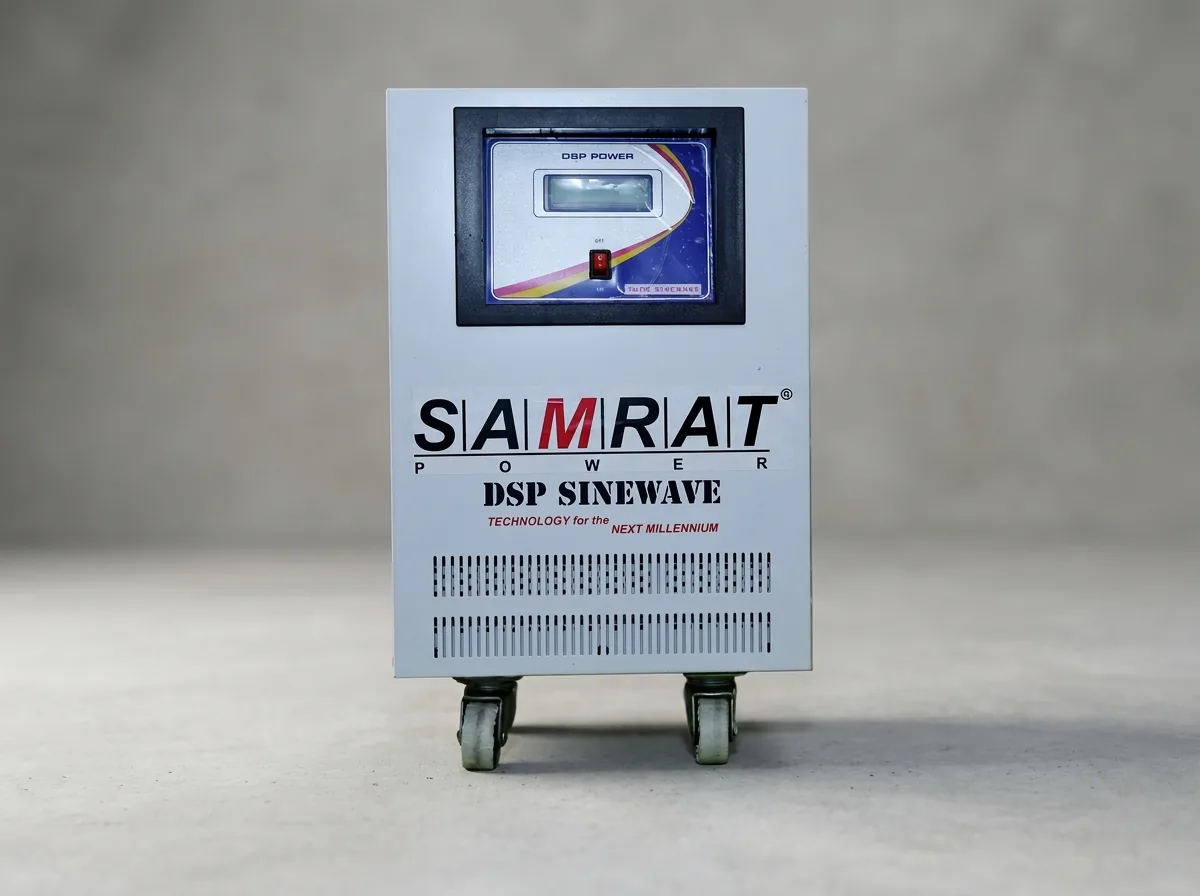
Solar Inverter · DSP Sine Wave
Hybrid PCU with DSP sine wave output and seamless mains bypass — runs the house on solar by day and stored power by night.
₹37,760 incl. GST · 24-month warranty
What actually happens across a year
Annual averages hide the problem. A system sized on 4.75 peak sun hours will spend part of the year comfortably above that and part well below, and it is the bad weeks that determine whether you are satisfied.
| Period | Relative output | What drives it |
|---|---|---|
| March–May | Highest | Long clear days; heat slightly reduces panel efficiency |
| June–September | Reduced | Monsoon cloud, though rain does clean the panels |
| October–November | High | Clear skies, mild temperatures — often the best of the year |
| December–January | Lowest | Short days, fog, and heavy dust deposition |
December and January are the constraint in north India, and they are worse than the numbers suggest because two effects compound: fewer daylight hours, and a persistent haze that cuts irradiance even at midday. A system that comfortably covers your load in October can leave the battery chronically short in January.
That chronic shortfall matters beyond inconvenience. A battery that never reaches a full charge never completes the constant-voltage phase, which is when cell balancing happens. Over a winter, a bank that is habitually left at 80% drifts out of balance and loses usable capacity — a problem the owner then attributes to the battery rather than to the array.
Two practical responses. Size the array toward the upper end of the 1.2–1.5× inverter VA range if you are north of roughly Jaipur. And clean the panels — in the Delhi winter, dust alone can cost 15–25% of output, and a wash every few weeks is the cheapest generation you will ever buy.
Five ways these systems get misspecified
- Sizing the inverter on running watts alone. The system works until someone starts the pump, then trips. Always size surge separately.
- Treating VA as watts. A 1,500 VA inverter delivers about 1,200 W on a domestic load. Sizing a 1,500 W load onto a 1,500 VA inverter leaves no margin at all.
- Undersizing the array to fit the budget. The battery then never reaches full, never balances properly, and ages faster. If money is tight, cut battery capacity before panel capacity.
- Ignoring winter. Delhi fog in December and January can halve output for weeks. A system sized on annual average will disappoint precisely when the grid is least reliable.
- Forgetting the future. An air conditioner added later is 1,200–1,800 W running and considerably more starting. If it is a possibility within three years, size for it now — adding panels later is easy, replacing an inverter is not.
A sixth, less obvious one: putting the battery somewhere hot. A lithium bank in a sealed cupboard against a west-facing wall will run far above room temperature through a Delhi summer, and calendar ageing roughly doubles for every 10 °C above about 30. The bank is the most expensive component and the easiest to site badly, because unlike panels it has no obvious placement requirement. Put it somewhere shaded and ventilated, and it will outlast the same bank in a hot cupboard by years.
The whole thing on one page
- List every load with running watts, surge watts and daily hours.
- Daily energy = sum of (running watts × hours).
- Inverter continuous VA ≥ (diversified running watts ÷ 0.8).
- Inverter surge ≥ largest single surge + concurrent running load.
- Night-time energy ≈ 60% of daily energy for a grid-tied home.
- Battery bank Wh = night energy × autonomy days ÷ depth of discharge ÷ inverter efficiency.
- Array watts = daily energy ÷ (peak sun hours × 0.75).
- Check array watts sits between 1.2× and 1.5× inverter VA.
If you would rather not do the arithmetic, send us your appliance list with rough daily hours and your city and we will size it for you. We will also tell you when a smaller system than you asked about would do the job — get in touch.
Frequently asked questions
How do I size a solar inverter for my home?
Two numbers, not one. The continuous rating must exceed your diversified simultaneous running load — total running watts times roughly 0.7 — divided by a power factor of about 0.8 to convert watts to VA. The surge rating must exceed your largest single appliance surge plus whatever is already running at that moment. For a typical Indian home running lights, fans, a fridge, a TV and a 0.5HP pump, that works out to about 1,080W continuous and 2,530W surge, which a 1,500VA inverter with 2–3× surge capability covers.
What size battery bank do I need for solar?
Work from night-time energy, not total daily energy — roughly 60% of daily consumption for a grid-connected home, since solar feeds the load directly during daylight. Then divide by depth of discharge (0.9 for LFP, 0.5 for lead-acid) and by inverter efficiency (about 0.9), and multiply by your days of autonomy. A home using 6,453Wh a day needs about 4,778Wh of storage for one day of autonomy on LFP, so a 5kWh bank.
How many solar panels do I need?
Divide daily energy consumption by peak sun hours multiplied by a system derate of 0.75. Delhi averages 4.5–5.0 peak sun hours, so a home using 6,453Wh a day needs about 1,812W of panels — four 450W panels. Round up rather than down; panels are the cheapest part of the system per unit of output, and an undersized array leaves the battery chronically short in winter.
What is the difference between running watts and surge watts?
Running watts is what an appliance draws once it is going. Surge watts is the momentary demand while a motor starts, typically two to six times higher. A 0.5HP water pump runs at 375W but surges to around 1,900W. The inverter must survive the surge; the battery bank supplies the running load. Sizing an inverter on running watts alone is the most common reason a solar system trips when the pump starts.
Is lithium worth it for solar storage compared with tubular batteries?
More so than for vehicles, because solar cycles the battery fully every single day — the duty lead-acid handles worst. Storing the same 3,870Wh needs about 8.6kWh of lead-acid nameplate at 50% depth of discharge against 4.8kWh of LFP at 90%, which is 250kg against 45kg. Lead-acid gives three to four years of daily cycling; LFP gives eight to fifteen, with no watering and no ventilated battery room.
Do I need a pure sine wave inverter?
For anything with a motor or a modern electronic power supply, yes. A modified square wave runs resistive loads such as heaters fine, but makes induction motors — fans, pumps, fridge compressors — run hotter, less efficiently and often audibly. It stresses switch-mode supplies in TVs, laptops and LED drivers too. The damage shows up as shortened appliance life rather than inverter failure, which makes it easy to miss.