
A lithium pack does not wear out the way a mechanical part does. It ages along two separate tracks at the same time, and understanding which one you are on explains almost every question owners have about battery life.
Cycle ageing is wear from use — every charge and discharge causes a small, irreversible loss. Calendar ageing is degradation that happens with the passage of time whether the pack is used or not, driven mostly by temperature and by the state of charge the pack sits at.
A delivery rider cycling a pack hard every day is limited by cycle ageing. A pack sitting fully charged on a shelf in a Delhi summer is being destroyed by calendar ageing while doing no work at all. Most owners only think about the first.
Heat, which matters more than everything else combined
If you take one thing from this page: temperature is the dominant variable in lithium battery life, and it is not close.
The widely used approximation is that the rate of calendar ageing roughly doubles for every 10 °C rise above about 30 °C. That is an exponential relationship, and exponentials are unintuitive.
| Average pack temperature | Relative ageing rate | What this looks like in practice |
|---|---|---|
| 25 °C | 1.0× (baseline) | Indoor storage, mild climate |
| 35 °C | ~2× | Ordinary Indian ambient much of the year |
| 45 °C | ~4× | Summer, vehicle in the sun |
| 55 °C | ~8× | Pack in a sealed enclosure, working hard |
A pack averaging 45 °C is ageing four times faster than the same pack at 25 °C. This single factor explains most of the gap between a manufacturer’s cycle rating, measured in a temperature-controlled laboratory, and what packs actually deliver in Indian service.
What you can do about it:
- Park in shade. The cheapest battery life extension available. A vehicle in direct afternoon sun can have a pack 15 °C above ambient.
- Do not charge a hot pack immediately. Give it twenty minutes after a hard run. Charging adds its own heat on top of what is already there.
- Give the enclosure air. A pack boxed tightly into sealed steel will run 10–15 °C hotter than one with airflow around it, for no reason at all.
- Do not store a pack in a hot room. A spare pack in a tin-roofed shed in May is being consumed while you look at it.
Depth of discharge
Every full cycle costs a little capacity. But cycles are not equal — a shallow cycle costs far less than a deep one, and not proportionally less.
Discharging a pack to 20% and recharging is much gentler than running it to 0% and recharging. The cells are most stressed at the extremes: very high state of charge holds them at maximum voltage, and very low state of charge approaches the point where the copper collector begins to suffer.
| Depth of discharge | Approximate cycles to 80% | Total energy delivered (relative) |
|---|---|---|
| 100% | ~3,000 | 1.00 |
| 80% | ~4,500 | 1.20 |
| 60% | ~7,000 | 1.40 |
| 50% | ~9,000 | 1.50 |
Read the third column carefully, because it is the one that matters and it is not what people expect. Cycling shallowly gives you more total lifetime energy — but only 20% more at 80% depth, and 50% more at 50% depth. You are not doubling the pack’s useful output by being gentle; you are getting a modest improvement in exchange for carrying capacity you never use.
Do not contort your operation to keep the pack between 20% and 80%. For a commercial vehicle, using the full pack and buying a slightly larger one is a better strategy than under-using a small one. The place shallow cycling genuinely pays is where the pack is oversized anyway, such as a solar bank that only occasionally goes deep.
The weekly full charge
This is the most commonly missed piece of maintenance on a lithium pack, and it costs nothing.
Cells in a series string drift apart over time. The BMS corrects this by balancing — but passive balancing, which is what nearly every traction pack uses, only operates during the constant-voltage phase at the very top of a charge. If you never finish a charge, the BMS never gets the opportunity.
An operator who tops up to 80% between shifts all week is running an increasingly unbalanced pack. The symptom is a steady loss of usable range with no individual cell failing: the pack stops charging early because one cell hits its limit first, and stops discharging early because another empties first. Both ends get squeezed.
The fix is to let the pack complete a full charge at least once a week — and crucially, let the taper finish. When the charger drops out of constant current and the current starts falling, that is when balancing happens. Unplugging at that point because “it is basically full” defeats the entire purpose.
Cold weather
Two separate issues, and only one of them is a problem.
Reduced range in the cold is normal and temporary. An LFP pack at 5 °C delivers roughly 10–15% less usable capacity than at 25 °C, because the electrolyte is more viscous and internal resistance rises. It recovers completely as the pack warms. Every January we field calls from owners convinced their pack has failed; almost none of them have.
Charging a lithium cell below freezing plates metallic lithium onto the anode instead of storing it in the graphite. That damage is permanent, cumulative and eventually grows dendrites that pierce the separator and short the cell internally. It applies to LFP and NMC alike. In Delhi, Punjab, Haryana and the hill states, a vehicle parked outside overnight in January can easily be below zero at dawn.
A BMS with a low-temperature charge cut-off blocks this automatically, and it is one of the specifications most often omitted from cheap boards — see our BMS guide. If you are not certain your pack has one, bring it somewhere warmer and let it come up to temperature before plugging in. Discharging in the cold is fine; it is charging that does the damage.
Storing a pack
If a vehicle is going to stand for weeks or months — a seasonal business, a spare pack, a scooter between owners — how you leave it matters a great deal.
Calendar ageing depends strongly on state of charge. A cell held at 100% sits at its maximum voltage, which is chemically its most stressed condition. A cell held at 0% risks drifting below its safe floor through self-discharge. The best storage state is in the middle.
Charge or discharge to around 50–60%
Not full, not empty. This is the lowest-stress state for long-term storage.
Store somewhere cool
Temperature and state of charge compound. A pack at 100% in a hot room is the worst case by a wide margin; 50% in a cool room is close to negligible ageing.
Disconnect it
A BMS draws a small standby current, and a vehicle’s electronics often draw more. Over three months that can take a pack to a dangerous state of charge.
Check it every two or three months
Top back up to around 60% if it has drifted down. Five minutes, twice a season.
Give it a full charge before returning to service
This lets the BMS rebalance after the layup, before the pack goes back to work.
The charger itself
Everything above assumes the charger is correct for the pack. If it is not, no habit will save you. The essentials:
- Correct termination voltage — cell count × 3.65 V for LFP. Too low and the pack never fills; too high and cells go over-voltage.
- Sensible current — 0.2C to 0.3C for a traction pack. Higher works if the cells allow it, but adds heat, and heat is what this whole page is about.
- Not a lead-acid charger — it will float the pack indefinitely at full charge, which is precisely the condition that accelerates calendar ageing.
The full derivation is in our charger matching guide.
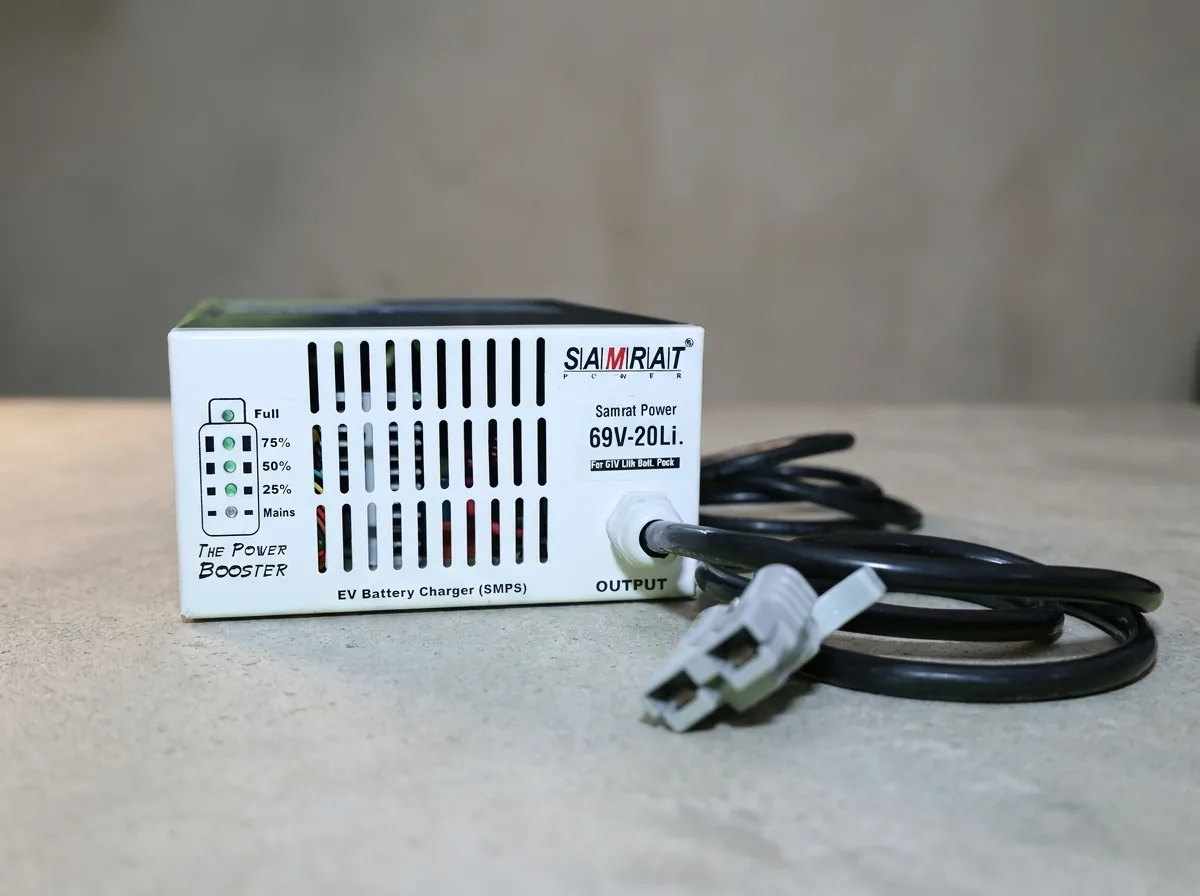
69V · 22A Lithium EV Charger
SMPS control with proper constant-current and constant-voltage phases, so the taper finishes and the BMS can balance. For 19S LFP packs.
₹5,460 incl. GST
Telling real degradation from everything else
“My range has dropped” is the most common message we get, and in most cases the pack is fine. Work through these in order before concluding the battery is failing.
| Pattern | Most likely cause | Reversible? |
|---|---|---|
| Appeared with the cold, same every day | Winter capacity reduction | Yes — returns with the weather |
| Worse in the afternoon than the morning | Thermal derating — pack too hot | Yes — shade and ventilation |
| Gradual over months, no other symptom | Cell imbalance from never finishing a charge | Often — run several full charges to completion |
| Sudden, over a week or two | A cell going bad, or a connection problem | Needs diagnosis, and quickly |
| Slow, over years, with everything else normal | Genuine capacity fade | No — this is the pack ageing as designed |
| Only since a new charger or repair | Wrong charger, or a controller setting changed | Yes |
Two non-battery causes are worth ruling out before any of the above, because they are extremely common and cost nothing to check. Tyre pressure that has drifted 10 psi low can cost 10–15% of range on its own. And brake drag from a partially seized caliper or an over-adjusted drum will quietly consume energy all day. We have had packs returned as faulty that turned out to be a binding rear brake.
If you have ruled all of that out and the loss is real, the useful measurement is capacity rather than range. A pack discharged from full to the BMS cut-off, with the energy measured, tells you exactly where it stands against its rating — and a pack at 85% of rating after three hard years is behaving normally, not failing.
Four things that are not true
“You must fully discharge a lithium battery before charging.” This is memory effect, which belongs to nickel-cadmium and does not exist in lithium. Deep discharging is mildly harmful, not beneficial. Top up whenever it is convenient.
“A new pack needs conditioning cycles.” Not in the way lead-acid does. What is true is that a new pack takes several full charges for the BMS to bring the cells into balance, so range may improve slightly over the first fortnight. That is balancing settling, not conditioning.
“Fast charging always ruins the battery.” Charging within the cells’ rated C-rate is fine. What harms them is heat, so fast charging a pack that is already hot, or a pack whose cells are not rated for that current, is genuinely damaging. Fast charging a cool pack that is rated for it is not.
“Leaving it plugged in overnight is dangerous.” With a correct lithium charger, it terminates and stops. It is still marginally better to unplug, because it avoids leaving the cells at their most stressed state for hours. With a lead-acid charger on a lithium pack, it genuinely is harmful.
A fifth, more damaging belief deserves adding: “the BMS will look after everything.” It will not. The BMS is a protection device of last resort — it stops conditions that would destroy cells outright. It cannot keep the pack cool, cannot correct for a charger that floats, cannot balance cells if you never finish a charge, and cannot undo the ageing caused by leaving a pack full in a hot room for a summer. Everything on this page is work the BMS cannot do for you.
The short list
If you do nothing else:
- Keep the pack cool. Shade, ventilation, and twenty minutes before charging after a hard run.
- Let it charge fully, taper included, at least once a week so the BMS can balance.
- Never charge below 0 °C.
- Store at 50–60%, cool and disconnected, if it is standing for weeks.
- Use the correct charger.
None of these cost anything, and together they are commonly the difference between a pack retired at year three and one still working at year six.
Frequently asked questions
What is the best way to charge a lithium battery to make it last?
Keep it cool, use a charger matched to the pack, and let it complete a full charge including the taper at least once a week. Heat is the dominant factor — the rate of calendar ageing roughly doubles for every 10°C above about 30°C — so shade, ventilation and waiting twenty minutes after a hard run before charging all matter more than anything about charge levels.
Should I keep my lithium battery between 20% and 80%?
Not at the cost of contorting your operation. Shallow cycling does extend life, but less than people assume: cycling to 80% depth rather than 100% yields only about 20% more total lifetime energy. For a commercial vehicle, using the full pack and buying a slightly larger one is a better strategy than habitually under-using a small one. Shallow cycling genuinely pays where the pack is already oversized, such as a solar bank.
Why should I fully charge my battery once a week?
Because passive cell balancing only happens during the constant-voltage taper at the very top of a charge. A pack that is habitually topped up to 80% and unplugged never balances, and the cells drift apart — the pack then stops charging early because one cell hits its limit first, and stops discharging early because another empties first. Let the taper finish; unplugging when it is “basically full” defeats the purpose.
Is it bad to charge a lithium battery in winter?
Charging below 0°C is genuinely damaging — it plates metallic lithium onto the anode instead of storing it in the graphite, and that damage is permanent and cumulative, eventually creating internal short circuits. Discharging in the cold is fine. Reduced range below about 10°C is normal, temporary and fully recovers when the pack warms. A BMS with a low-temperature charge cut-off blocks charging automatically; if you are not sure yours has one, warm the pack first.
How should I store a lithium battery for a few months?
At 50–60% state of charge, somewhere cool, and disconnected. A cell held at 100% sits at its most chemically stressed state, and one held near 0% risks self-discharging below its safe floor. Temperature and state of charge compound, so a full pack in a hot room is much the worst case. Check every two or three months and top back up to about 60%, then give it a full charge before returning it to service so the BMS can rebalance.
Does fast charging damage a lithium battery?
Not by itself. Charging within the cells’ rated C-rate is fine — 0.2C to 0.3C is the usual recommendation for traction packs. What causes damage is heat, so fast charging a pack that is already hot, or pushing current beyond what the cells are rated for, is genuinely harmful. Fast charging a cool pack that is specified for it is not.