
“Lithium battery” is not a specification. It describes a family, and within that family the two chemistries that matter for Indian vehicles and storage behave differently enough that choosing wrongly costs you either money or years of pack life.
Lithium iron phosphate — LFP, or LiFePO4 — and lithium nickel manganese cobalt oxide — NMC. This guide compares them on the criteria that actually decide it here, which are not the criteria a datasheet leads with.
What is physically different
Both chemistries move lithium ions between a graphite anode and a metal-oxide cathode. The cathode is the difference, and everything else follows from it.
NMC uses a nickel-manganese-cobalt oxide, a layered structure that holds a lot of lithium in a small volume — hence high energy density. LFP uses iron phosphate in an olivine structure, which holds less lithium per unit volume but is chemically far more stable. Phosphorus and oxygen are strongly bonded in the phosphate group, so LFP is much more reluctant to release oxygen when it gets hot. Oxygen release is what turns a thermal event into a fire.
| Property | LFP | NMC | Which is better |
|---|---|---|---|
| Nominal cell voltage | 3.2 V | 3.6–3.7 V | NMC — fewer cells for the same pack voltage |
| Energy density | 90–160 Wh/kg | 150–250 Wh/kg | NMC, clearly |
| Cycle life to 80% capacity | 2,000–6,000 | 1,000–2,000 | LFP, by a wide margin |
| Thermal runaway onset | ~270 °C | ~210 °C | LFP |
| Tolerance of sustained heat | Good | Moderate | LFP |
| Cold performance | Poorer | Better | NMC |
| Cost per kWh of cells | Lower | Higher | LFP |
| Contains cobalt | No | Yes | LFP — supply and ethics |
| Voltage curve | Very flat | Sloped | NMC — easier state-of-charge estimation |
Read that table quickly and NMC looks competitive: it wins on density, cold weather and gauge accuracy. Read it in the context of a Delhi summer and a commercial duty cycle, and the picture changes completely.
Why heat decides it here
This is the section that matters. Every other consideration is secondary in the Indian market.
Lithium cells age chemically as well as by cycling, and that ageing is exponential in temperature. The commonly used rule of thumb is that calendar ageing roughly doubles for every 10 °C rise above about 30 °C. A pack living at 45 °C ambient is not slightly worse off than one at 25 °C; it is losing life several times faster.
Now consider where a traction pack actually sits: under a vehicle, in still air, absorbing road heat from below and sun from above, while dissipating its own I²R losses. A 43 °C Delhi afternoon becomes a pack running at 50 °C or more internally, and it stays there for the hottest six hours of the day, for three months of the year.
LFP handles this materially better than NMC. It is not that LFP does not age in heat — it does — but it degrades more slowly and, critically, its failure mode is gentler. An overheated LFP cell loses capacity. An overheated NMC cell is much closer to releasing oxygen and going into thermal runaway, and once one cell in a pack does that, the heat it releases can propagate to its neighbours.
The thermal propagation requirements added to India’s traction battery standard are aimed squarely at the scenario where one failing cell takes the pack with it. LFP’s higher runaway threshold and lower energy release make that scenario far easier to design against. See our guide to battery safety standards in India.
Cycle life, and what the numbers mean
A cycle rating is meaningless without the capacity threshold attached to it. “3,000 cycles” should always read “3,000 cycles to 80% of rated capacity”, meaning that after 3,000 full charge-discharge cycles the pack still holds four-fifths of what it started with.
Translate the two chemistries into years of commercial service:
| LFP at 3,000 cycles | NMC at 1,500 cycles | |
|---|---|---|
| Years to 80% capacity | 10 years | 5 years |
| Realistic service life allowing for heat | 5–7 years | 3–4 years |
| Replacements in a 10-year window | 1–2 | 3 |
The middle row is the honest one. Cycle ratings come from laboratory testing at controlled temperature, and no Indian commercial vehicle operates at controlled temperature. Both chemistries fall short of their laboratory numbers in service; NMC falls further short because heat hurts it more.
For a commercial operator, replacing the pack once instead of three times over a decade is the entire argument. It dwarfs the purchase-price difference.
When density actually matters
NMC’s advantage is real, and there are applications where it is decisive.
NMC stores roughly 50–60% more energy per kilogram. For a given energy, an NMC pack is lighter and smaller. That matters enormously when the vehicle is weight-constrained or the space is fixed — performance motorcycles, drones, laptops, and passenger cars where every kilogram costs range.
It matters very little on a three-wheeler. An e-rickshaw already weighs 350 kg empty and carries 300 kg of passengers. Saving 15 kg of battery mass on a 650 kg loaded vehicle is a 2% change — not nothing, but nothing like enough to accept half the cycle life and a lower thermal margin.
The place the calculation genuinely tightens is two-wheelers. A scooter is weight-sensitive and space-constrained, and NMC has historically held a real position there. Even so, the Indian market has moved decisively toward LFP for two-wheelers as well, because the fires that shaped public opinion and regulation in this segment were not LFP fires. Our own e-scooty battery is LFP for exactly that reason, and we accept the weight penalty deliberately.
The cold-weather caveat
LFP’s real weakness. Below about 10 °C, an LFP pack delivers noticeably less usable capacity — commonly 10–15% less at 5 °C, and more than that approaching freezing. NMC suffers too, but less.
Two things to say about this. First, the loss is temporary. Capacity returns when the pack warms. A driver who thinks a January range drop means the pack is failing is misreading normal behaviour.
Second, the serious issue is not discharge but charge. Charging any lithium cell below 0 °C plates metallic lithium onto the anode instead of intercalating it. That damage is permanent, cumulative, and eventually creates internal short circuits. It applies to both chemistries, and it is one of the reasons a BMS with a low-temperature charge cut-off is not optional in north India.
Never charge a lithium pack that is below 0 °C, whatever the chemistry. In Delhi, Punjab, Haryana and the hill states this is a real January scenario for a vehicle parked outside overnight. Bring the pack indoors, or use a BMS that blocks charging until it warms.
The flat curve problem
An LFP cell spends most of its discharge between 3.2 V and 3.3 V. Across roughly 70% of its usable energy, the voltage barely moves.
Electrically this is excellent — the motor sees a near-constant supply from full to nearly empty, which is why LFP vehicles do not feel progressively weaker as they discharge the way lead-acid ones do. For fuel gauging it is a genuine nuisance. A simple voltmeter-based gauge on an LFP pack will show “full” for hours and then collapse with little warning.
NMC’s sloped curve makes voltage a usable proxy for state of charge. With LFP you need a BMS that counts coulombs — integrating current in and out over time — to produce a meaningful percentage. This is a real cost difference between a cheap protection board and a proper smart BMS, and it is one of the places corners get cut. Our BMS guide covers what to look for.
Cost per usable kWh, over the pack’s life
Comparing purchase prices per kWh is the wrong comparison, and it flatters NMC. The right one divides what you pay by the total energy the pack will deliver before it retires.
Take two packs of the same nameplate energy, 6 kWh, and follow them through their working lives.
| LFP | NMC | |
|---|---|---|
| Purchase price (illustrative) | ₹62,000 | ₹72,000 |
| Usable energy per cycle at 90% / 85% DoD | 5.40 kWh | 5.10 kWh |
| Realistic cycles in Indian heat | 2,200 | 1,100 |
| Lifetime energy delivered | 11,880 kWh | 5,610 kWh |
| Cost per usable kWh delivered | ₹5.22 | ₹12.83 |
The prices are illustrative and the cycle figures are deliberately conservative for both — they are laboratory ratings discounted for the heat a real Indian pack lives in. But the ratio is the point: on this basis LFP delivers energy at well under half the lifetime cost, and the gap comes almost entirely from cycle life rather than from purchase price.
This is why the argument that “NMC is cheaper per kWh” is misleading. It is cheaper per kWh of capacity, bought once. It is considerably more expensive per kWh delivered, which is the thing you are actually buying. The only way NMC wins this comparison is if the pack is retired for reasons other than capacity loss — the vehicle is sold, the product is replaced, or the application genuinely could not tolerate the extra weight.
The recommendation
| Application | Our recommendation | Why |
|---|---|---|
| E-rickshaw, e-cart, e-loader | LFP | Heat, cycle life and safety all dominate. Weight is irrelevant on a three-wheeler. |
| E-scooter / two-wheeler | LFP | Weight penalty is real but acceptable; safety and cycle life matter more in a vehicle parked inside homes. |
| Home inverter / solar storage | LFP | Stationary, so weight is irrelevant; cycle life is everything for daily solar cycling. |
| Industrial UPS, telecom | LFP | Long float life, heat tolerance, and a failure mode you can live with in an occupied building. |
| Weight-critical or space-critical | NMC | Where energy per kilogram genuinely governs the design and thermal management can be engineered. |
We build in LFP for every product on this site, and the reason is not that NMC is a bad chemistry. It is that NMC’s single advantage — energy density — is the one thing Indian commercial vehicles and stationary storage do not need, while its disadvantages sit exactly where Indian conditions apply the most pressure.
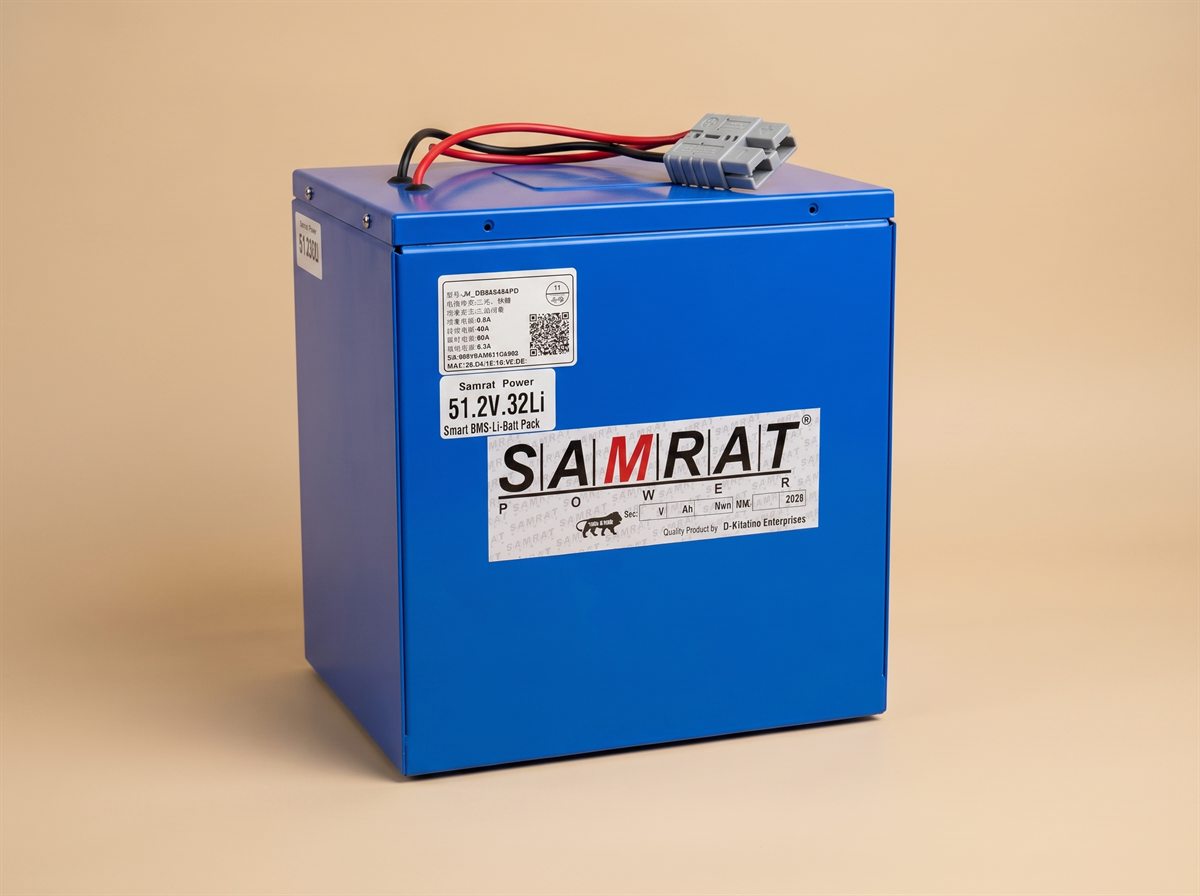
E-Scooty Battery (LFP)
LFP for a two-wheeler, deliberately. 150+ km range, about two hours to charge, smart BMS and our longest warranty.
From ₹23,600 incl. GST · 36-month warranty
One place NMC wins that nobody mentions
End of life. It is a small factor today and a growing one, and it runs the opposite way to everything above.
An NMC cathode contains nickel and cobalt, both genuinely valuable. A recycler recovering them has a strong commercial incentive, which means a scrap NMC pack has real residual worth. LFP contains iron and phosphate — cheap, abundant materials — so the recoverable value is largely the lithium itself plus the copper and aluminium in the current collectors and casing. LFP recycling is technically straightforward but economically thinner.
Under India’s Battery Waste Management Rules the obligation to collect and recycle sits with producers regardless of chemistry, so this does not become your problem as a buyer. But it does mean a retired NMC pack may be worth something to a recycler where an LFP pack of the same size is closer to break-even, and that gap will influence how take-back schemes are priced over the next few years.
It also points at where LFP’s longer life pays a second time: a pack retired from vehicle duty at 80% capacity is still a perfectly good stationary storage battery. LFP’s remaining cycle life at that point is substantially greater, which makes second-life reuse a realistic route rather than a theoretical one. We cover both paths in our guide to Li-ion recycling and second life in India.
How to check what you are actually being sold
Plenty of packs are sold as “lithium” without the chemistry being stated anywhere, and the price often tells you why. Three ways to find out:
- Ask for the cell make and model number. A supplier who will not name the cell is telling you something. The model number identifies the chemistry immediately.
- Count the cells against the pack voltage. A 60 V pack with nineteen cells in series is LFP (19 × 3.2 = 60.8). A 60 V pack with sixteen is NMC (16 × 3.7 = 59.2). The series count is the giveaway and is usually visible from the BMS.
- Check the charger voltage. Same arithmetic from the other direction: a 69 V charger implies 19S LFP, an 84 V charger implies either 23S LFP or 20S NMC. See the charger guide.
If you are specifying a pack and want to talk the chemistry choice through against your actual duty cycle rather than a table, get in touch. There are applications where we would tell you NMC is the better answer, and we would rather say so.
Frequently asked questions
Is LFP better than NMC for Indian conditions?
For nearly all Indian vehicle and storage applications, yes. LFP tolerates sustained heat far better, delivers two to three times the cycle life, has a thermal runaway threshold around 270°C against roughly 210°C for NMC, and costs less per kWh. NMC’s advantage is energy density — 150–250 Wh/kg against 90–160 — which matters when weight or space governs the design, and rarely governs a three-wheeler or a stationary storage bank.
What is the difference between LFP and NMC batteries?
The cathode. NMC uses a layered nickel-manganese-cobalt oxide that stores more lithium per unit volume, giving higher energy density. LFP uses iron phosphate in an olivine structure, where the phosphorus-oxygen bond is strong enough that the cell is far more reluctant to release oxygen when hot. That single chemical difference produces LFP’s better safety margin, longer cycle life and lower cost, and NMC’s higher density.
How long does an LFP battery last compared to NMC?
LFP is typically rated at 2,000–6,000 cycles to 80% capacity against 1,000–2,000 for NMC. In Indian commercial service, allowing for heat, that translates to roughly 5–7 years for LFP and 3–4 for NMC. Over a ten-year horizon that is one or two pack replacements instead of three, which usually dwarfs the purchase-price difference.
Does LFP perform badly in cold weather?
It delivers less usable capacity below about 10°C — commonly 10–15% less at 5°C — and the loss is greater approaching freezing. The loss is temporary and returns fully as the pack warms. The serious cold-weather issue is charging, not discharging: charging any lithium cell below 0°C plates metallic lithium onto the anode and causes permanent cumulative damage. That applies to NMC too, and is why a low-temperature charge cut-off in the BMS matters in north India.
Why does my LFP battery gauge drop suddenly near the end?
Because the LFP discharge curve is very flat — the cell sits between about 3.2V and 3.3V across roughly 70% of its usable energy. A gauge that estimates charge from voltage alone therefore reads “full” for a long time and then falls quickly. It is a property of the chemistry, not a fault. Accurate gauging on LFP requires a BMS that counts coulombs rather than watching voltage.
How can I tell whether a pack is LFP or NMC?
Count the cells in series against the pack voltage. A 60V pack with nineteen cells is LFP (19 × 3.2 = 60.8V); with sixteen cells it is NMC (16 × 3.7 = 59.2V). You can work backwards from the charger too — a 69V charger implies 19S LFP. Failing that, ask for the cell make and model number; a supplier unwilling to name the cell is worth being cautious about.