
Almost every e-rickshaw in India left the factory with four 12 volt lead-acid batteries wired in series. That is a 48 volt system, and when the owner comes to replace it with lithium, a 48 volt lithium pack is the natural like-for-like swap.
It is also the configuration people get wrong most often, because a “48V lithium pack” is not 48 volts. This guide covers what it actually is, how much capacity you need, what it will and will not do, and the point at which you should be looking at 60V instead.
What a 48V lithium pack actually is
Sixteen LFP cells in series. That is the whole definition.
An LFP cell sits at 3.2 V nominal, so sixteen of them give 51.2 V nominal. The market calls it 48V because it drops into the slot a 48 V lead-acid set left behind, and because 51.2V is an awkward thing to put on a poster. You will see the same pack described three ways — 48V, 51.2V and 16S — and all three are correct.
| State | Per cell | Whole pack | What it means |
|---|---|---|---|
| Fully charged | 3.65 V | 58.4 V | What the charger must deliver |
| Nominal | 3.20 V | 51.2 V | What the label says |
| Fully discharged | 2.50 V | 40.0 V | Where the BMS disconnects |
The practical consequence is that you need a charger rated around 58 V, not 48 V. Ours is the 58V · 25A lithium charger. If that seems like an odd number, our charger matching guide works through the arithmetic in full.
A 16S LFP pack still reads 48 V when it is nearly empty — the LFP discharge curve is famously flat. Your controller’s low-voltage cut-off, if it was set for lead-acid, is probably around 42 V, which the pack only reaches when it is already at the BMS floor. In practice the BMS ends up doing the cut-off instead of the controller, which is not what either is designed for. Reset the controller cut-off to about 44 V when you fit the pack.
Choosing capacity
Voltage is fixed by your vehicle. Capacity is the decision you actually make, and it is entirely driven by how far you drive in a day.
The working number is energy consumption per kilometre. A loaded e-rickshaw with an 850–1000 W BLDC motor uses roughly 40 to 55 Wh per kilometre. Traffic, passenger load, tyre pressure and how hard the driver accelerates all move it within that band. We use 45 Wh/km for planning.
| Capacity | Nameplate energy | Usable energy | Realistic range | Suits |
|---|---|---|---|---|
| 51.2V 60Ah | 3.07 kWh | 2.76 kWh | ~61 km | Short fixed routes, feeder services |
| 51.2V 80Ah | 4.10 kWh | 3.69 kWh | ~82 km | Single-shift city driving |
| 51.2V 100Ah | 5.12 kWh | 4.61 kWh | ~102 km | The common commercial choice |
| 51.2V 120Ah | 6.14 kWh | 5.53 kWh | ~123 km | Long shifts, no midday charging access |
Two things to say about that table before you use it.
First, those ranges assume a healthy pack in mild weather with a moderate load. Add four adult passengers, a July afternoon, and a route with flyovers, and you should plan on 15–20% less. A pack sized exactly to your daily distance will disappoint you within a month.
Second, buying more capacity than you need is not wasted money in the way it would be with lead-acid. A larger pack is cycled less deeply for the same daily distance, and shallower cycles mean more of them. A 120 Ah pack doing 80 km a day will outlive a 100 Ah pack doing the same 80 km, by a margin that often covers the price difference.
Take your longest realistic day in kilometres, multiply by 50 Wh to build in a margin, divide by 51.2 V, then divide by 0.9 for usable depth. That is your minimum amp-hour rating. For a 90 km day: 90 × 50 = 4,500 Wh; ÷ 51.2 = 88 Ah; ÷ 0.9 = 98 Ah. Buy the 100 Ah.
Current draw, and why it is the number that breaks things
Range gets all the attention. Current is what actually determines whether the pack survives.
Power is volts times amps. A 1,000 W motor on a 51.2 V pack draws about 20 A when cruising. That is the easy part. The problem is what happens when the rickshaw pulls away from a standstill with a full load on an incline: motor current on an e-rickshaw commonly peaks at 45–60 A, and controllers are often set to allow considerably more for short bursts.
So the pack has to supply roughly 20 A continuously and tolerate 60 A spikes many times an hour, all day, in ambient temperatures that reach 45 °C. This is a demanding duty, and it is where cheap packs fail.
- BMS continuous rating. Ask for the continuous figure, not the peak. A BMS advertised at “100 A” is often 100 A peak and 40 A continuous. For an e-rickshaw you want at least 60 A continuous.
- Cell discharge rating. A 100 Ah pack drawing 60 A is 0.6C, which is comfortable for LFP. An 60 Ah pack drawing the same 60 A is 1C, which is not comfortable at all in summer. Smaller packs work harder for the same vehicle.
- Interconnects and cabling. Nickel strip that is adequate at 20 A gets warm at 60 A. Heat at a joint is the beginning of most pack failures.
This is the quiet argument for 60V that we will come to shortly: at a higher voltage, the same motor power needs less current, and everything downstream gets easier.
How the pack is physically put together
Two 51.2 V 100 Ah packs can be built to wildly different standards for wildly different prices, and almost none of the difference is visible from the outside. It is worth knowing what is inside the box you are buying.
Cells and configuration
A 100 Ah 16S pack can be built from sixteen 100 Ah prismatic cells (16S1P), or from thirty-two 50 Ah cells in pairs (16S2P), or from a large number of small cylindrical cells. Prismatic 16S1P is the cleanest arrangement for traction duty: fewer connections, fewer things to go wrong, and every cell individually monitored by the BMS. Multi-parallel builds using cylindrical cells are cheaper and pack into awkward shapes better, but a parallel group is monitored as one unit — a single failing cell inside a group of eight is invisible until the group as a whole starts to sag.
Interconnects
Cells are joined either with laser-welded nickel strip or with bolted busbars. The failure mode to worry about is resistance at a joint: a connection with even a few milliohms of extra resistance dissipates heat every time current passes, that heat degrades the joint further, and the process accelerates. Most packs that fail early fail here rather than in the cells. Bolted busbars need to be torqued correctly and checked; welded joints need to be welded properly in the first place.
Casing and ingress
The pack lives under a rickshaw. It will see road spray, dust, and a monsoon at least once a year. A powder-coated metal enclosure with sealed cable glands is the appropriate answer; a plastic box with a cable passing through a drilled hole is not. Ask what ingress protection the enclosure offers — IP65 means dust-tight and protected against water jets, which is the sensible minimum for this application.
What it should weigh
A 51.2 V 100 Ah LFP pack in a metal case comes out around 40–45 kg. If a quoted pack is dramatically lighter, either the cells are not LFP or the capacity is not what the label says. Weight is a surprisingly good sanity check on a specification.
What it replaces, and what changes
| 4 × 12V 120Ah lead-acid | 51.2V 100Ah LFP | |
|---|---|---|
| Weight | ~120 kg | ~42 kg |
| Usable energy | 3.17 kWh | 4.61 kWh |
| Range at 45 Wh/km | ~70 km | ~102 km |
| Charge time | 8–10 hours | ~5 hours at 25 A |
| Maintenance | Water top-up every 4–6 weeks | None |
| Expected life | 12–18 months | 3,000 cycles / 5–7 years |
The weight change deserves a sentence of its own. Removing 78 kg from a vehicle that weighs perhaps 350 kg empty is a meaningful change to how it drives, brakes and corners, and it improves consumption per kilometre by a few percent on its own. It also changes how the tray must be built: a lithium pack that is a third of the weight will slide if it is simply set into a well designed to hold lead by mass alone. It has to be clamped.
For the full cost comparison, including the point at which the switch pays for itself, see lithium vs lead-acid: the five-year arithmetic.
When 48V is the wrong answer
We sell both, so we have no reason to push you either way. There are four situations where we would tell you to go to 60V.
Your vehicle is already a 60V system
Obvious, but worth stating: if it came with five 12 V batteries, it is a 60 V vehicle and the controller and motor are wound for it. Do not fit a 48 V pack to it.
You routinely carry a full load on gradients
At 60 V the same motor power is delivered at about 17% less current. Less current means less heat in the controller, the cables and the cells — and noticeably better pull when the vehicle is loaded. Drivers describe it as the rickshaw feeling stronger, and they are not imagining it.
You want more than about 120 km a day
Getting there on 16S means a very large pack. At 19S the same energy comes in a physically smaller, lighter package because you are adding cells in series rather than in parallel.
Your controller is running hot
Controller heat is a current problem, and raising the system voltage is the direct fix.
Against that, 48V has genuine advantages: the pack is cheaper, the components are more widely available, and any electrician in the country has seen a 48 V system. If your daily distance is under 90 km, your load is moderate and your vehicle is a 48 V vehicle, there is no reason to change.
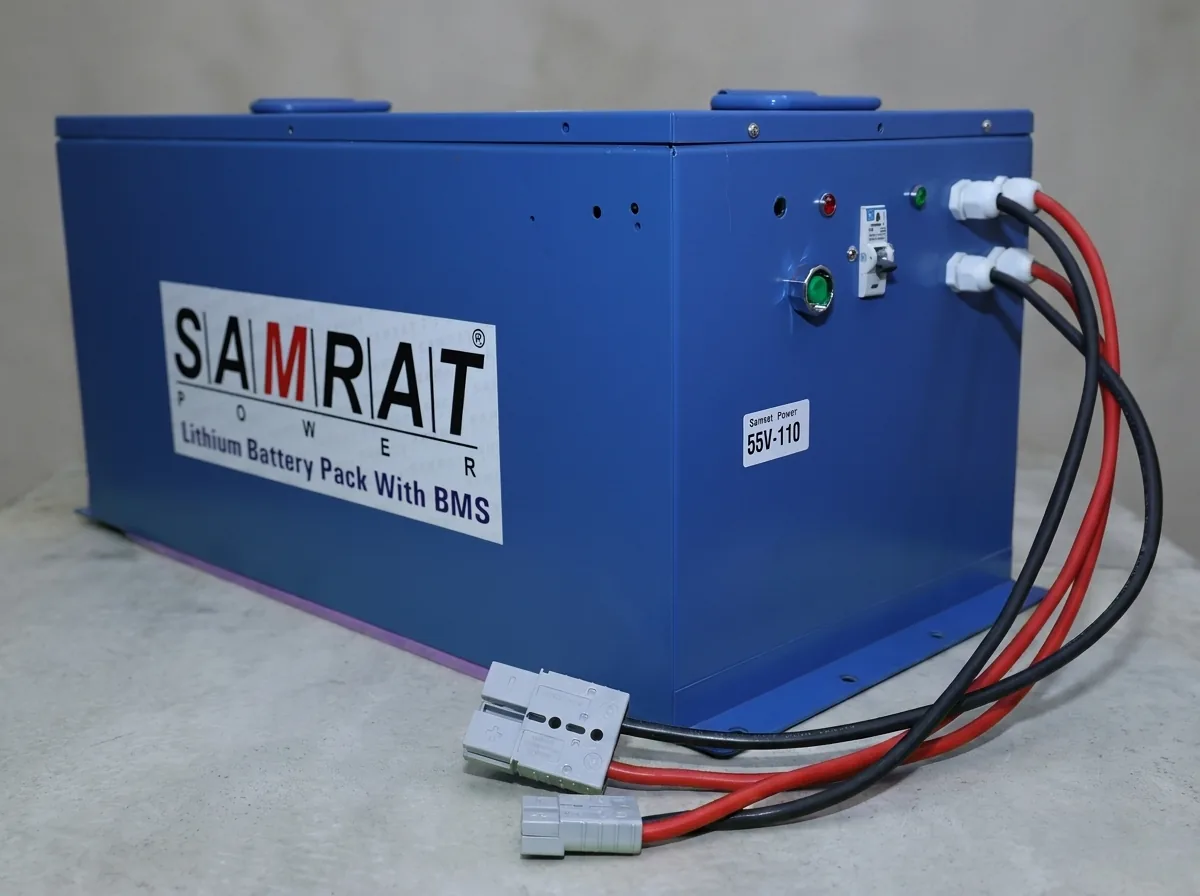
Customized Lithium Battery Pack
We build 16S LFP packs to your capacity, casing and connector, with a smart BMS rated for e-rickshaw duty. Assembled and tested in New Delhi. 36-month warranty.
Price on request
What to put in your enquiry
A pack quote is only as good as the specification behind it. Send us these and we can price it accurately the first time:
- Vehicle and motor rating — make, model, and the motor’s watt rating if you know it.
- Daily distance on your longest realistic day, not your average.
- Typical load — passengers, cargo, or both.
- Available space in the battery tray, in millimetres. This constrains the capacity more often than budget does.
- Existing charger, if any, and whether you want us to supply the matching one.
- Connector type — a photograph is worth more than a description.
If you are not sure about the motor rating or the tray dimensions, send what you have. We would rather ask two follow-up questions than quote you a pack that does not fit.
What to expect in service
A well-built 16S LFP pack in daily commercial use should be unremarkable, which is the point. A few things are normal and worth knowing so you do not misread them:
- Range drops in winter. Below about 10 °C an LFP pack delivers less usable capacity — typically 10–15% less at 5 °C. It comes back when the weather does. Nothing is wrong.
- The charge indicator is not linear. The LFP discharge curve is flat, so a simple voltage-based gauge will read “full” for a long time and then fall quickly. This is a property of the chemistry, not a fault.
- The first few cycles settle. Cell balancing takes several full charges to bring a new pack into equilibrium. Range often improves slightly over the first fortnight.
- Capacity fades slowly and then stops mattering. Expect to be at roughly 90% of rated capacity after a year of hard use, and around 80% at the pack’s rated cycle count. Eighty percent is the end of the warranty definition, not the end of the pack.
If range falls sharply rather than gradually, or one charge behaves very differently from the next, that is usually a cell balance problem and it is worth bringing to us early. Balance issues caught early are a service job; ignored, they take the pack.
Frequently asked questions
Is a 48V lithium battery actually 48 volts?
No. A “48V” lithium pack is sixteen LFP cells in series, which is 51.2V nominal, 58.4V fully charged and 40V fully discharged. It is called 48V because it replaces a 48V lead-acid set. This is why it needs a charger rated around 58V rather than 48V.
What capacity 48V lithium battery do I need for my e-rickshaw?
Take your longest realistic daily distance, multiply by 50Wh to build in margin, divide by 51.2 and then by 0.9 for usable depth of discharge. A 90km day works out to about 98Ah, so you would buy a 100Ah pack. For most commercial single-shift e-rickshaw operation, 100Ah is the common choice and gives roughly 100km of real-world range.
How far will a 48V 100Ah lithium battery take an e-rickshaw?
Around 100km on a moderate load in mild weather, working from 4.61kWh of usable energy at about 45Wh per kilometre. Expect 15–20% less with four adult passengers, in peak summer heat, or on a route with significant gradients. Winter temperatures below 10°C temporarily reduce it by a further 10–15%.
Should I choose 48V or 60V for my e-rickshaw?
Stay at 48V if your vehicle is a 48V system, your daily distance is under about 90km and your loads are moderate. Move to 60V if the vehicle is already a 60V system, if you routinely carry full loads on gradients, if you need more than about 120km a day, or if your controller runs hot. At 60V the same motor power needs roughly 17% less current, which reduces heat everywhere in the system.
Why does my range drop in winter?
LFP chemistry delivers less usable capacity in the cold — typically 10–15% less at 5°C than at 25°C. It is temporary and fully recovers as temperatures rise. What is not temporary is damage from charging a pack that is below freezing, which permanently plates lithium onto the anode. A good BMS blocks charging below 0°C.
What BMS rating do I need for an e-rickshaw?
At least 60A continuous. An e-rickshaw draws about 20A while cruising but peaks at 45–60A pulling away under load, many times an hour. Be careful with advertised figures: a BMS sold as “100A” is often 100A peak and only 40A continuous, which will trip repeatedly in service. Always ask for the continuous rating.