
A lead-acid battery set for an e-rickshaw costs roughly a quarter of what a lithium pack costs. That is the number that stops most drivers and fleet owners from switching, and it is a completely reasonable thing to worry about. ₹24,000 you can find. ₹62,000 you have to arrange.
But the purchase price is not the cost of the battery. The cost of the battery is what you pay to move a rickshaw one kilometre, over the whole life of the vehicle, and on that measure the two technologies are not close. This page works the comparison out properly — not with slogans, but with a spreadsheet you could rebuild yourself.
We manufacture lithium packs, so we have an obvious interest in the answer. That is exactly why every assumption below is written down. If you disagree with one, change it and see what happens to the total; several of them are genuinely arguable, and we say so where they are.
Nameplate capacity is not the capacity you get
The single biggest source of confusion in this comparison is that a 48V 120Ah lead-acid set and a 60V 100Ah lithium pack are quoted the same way but deliver very different amounts of work.
Multiply volts by amp-hours and you get nameplate energy. The lead-acid set: 48 × 120 = 5.76 kWh. The lithium pack: 60.8 × 100 = 6.08 kWh. On paper they look similar, and a salesman quoting only amp-hours can make the lead-acid set look like the better deal.
What matters is usable energy — how much of that nameplate you can actually take out before the battery is damaged or the rickshaw stops pulling.
| Lead-acid 48V 120Ah | LFP lithium 60.8V 100Ah | |
|---|---|---|
| Nameplate energy | 5.76 kWh | 6.08 kWh |
| Practical depth of discharge | ~55% | ~90% |
| Usable energy per cycle | 3.17 kWh | 5.47 kWh |
| Round-trip charging efficiency | ~75% | ~95% |
| Energy drawn from the wall per full cycle | 4.22 kWh | 5.76 kWh |
| Weight of the set | ~120 kg | ~45 kg |
The lithium pack does 72% more work per charge from a nameplate that is only 6% larger. Two things cause that gap.
The first is depth of discharge. Take a tubular lead-acid battery below about 50–55% regularly and its cycle life collapses — not gradually, but sharply. Drivers know this as “the battery died in eight months”. LFP lithium is comfortable at 90% depth of discharge for thousands of cycles. You are not being cautious with lead-acid by leaving 45% in the pack; you are being forced to.
The second is charging efficiency. Lead-acid loses a quarter of what you put into it as heat and gassing, and that loss gets worse as the battery ages. Lithium loses about 5%. You pay for the difference every single night.
If a lead-acid set and a lithium pack quote the same kWh on the label, the lithium pack will do roughly 1.7× the daily work. Compare usable kWh, not nameplate kWh, or you will systematically overpay for lead-acid.
The assumptions behind the sum
Everything below rests on these. They describe a hard-working single rickshaw in Delhi or a comparable city; adjust them to your own operation.
- Distance: 100 km per day, 300 working days a year — 30,000 km a year, 150,000 km over five years.
- Energy consumption: 45 Wh per km. A loaded e-rickshaw with an 850–1200 W BLDC motor typically sits between 40 and 55 Wh/km depending on passenger load, tyre pressure, road surface and how much stop-start traffic it sees.
- Electricity: ₹8 per unit. Many drivers charge at a shop or home connection where the marginal slab is higher; some charge at subsidised rates. This is the assumption most worth changing.
- Lead-acid set: ₹24,000 for a 48V 120Ah tubular set, replaced every 15 months under daily deep cycling.
- Lithium pack: ₹62,000 for a 60.8V 100Ah LFP pack with a smart BMS, rated for 3,000 cycles.
- Excluded from both: the vehicle, tyres, brakes, insurance and the driver — they are the same either way and would only pad the totals.
The 15-month lead-acid replacement interval is the assumption people push back on most. Manufacturers rate these sets for longer, and a battery that is shallow-cycled and watered on schedule genuinely lasts longer. But a commercial e-rickshaw doing 100 km a day is deep-cycling every single day, which is exactly the duty lead-acid handles worst. Fifteen months is what operators report; if your experience is 24 months, the sum still favours lithium, just later.
What each technology costs per kilometre
Range per charge first. Usable energy divided by consumption:
- Lead-acid: 3.17 kWh ÷ 0.045 kWh/km = 70 km per charge
- Lithium: 5.47 kWh ÷ 0.045 kWh/km = 121 km per charge
That difference alone changes the working day. On lead-acid, 100 km a day means either a partial second charge or accepting that the last few trips are made on a sagging pack. On lithium, 100 km is one charge with margin left.
Now the energy cost. Wall energy per cycle × tariff, divided by the kilometres that cycle delivers:
- Lead-acid: (4.22 kWh × ₹8) ÷ 70 km = ₹0.48 per km
- Lithium: (5.76 kWh × ₹8) ÷ 121 km = ₹0.38 per km
Note how modest that gap is: about ten paise a kilometre. Energy is not where lithium wins. Over 150,000 km it saves ₹15,000 — real money, but nothing like the headline. The decisive number is the one people leave out of the comparison entirely.
The five-year total
Over 60 months, the lead-acid operator buys a set at month 0, 15, 30 and 45 — four sets. The lithium operator buys one pack, and at 150,000 km ÷ 121 km per cycle it has done about 1,240 cycles, comfortably inside its 3,000-cycle rating.
| Lead-acid | LFP lithium | |
|---|---|---|
| Battery purchases | 4 × ₹24,000 = ₹96,000 | 1 × ₹62,000 = ₹62,000 |
| Electricity over 150,000 km | ₹72,000 | ₹57,000 |
| Five-year total | ₹1,68,000 | ₹1,19,000 |
| Cost per kilometre | ₹1.12 | ₹0.79 |
| Battery still has life left at year 5 | No — a fifth set is due | Yes — roughly 1,760 cycles remain |
- ₹49,000Saved over five years on one vehicle
- Month 30Where lithium moves ahead on cumulative cost
- 29%Lower cost per kilometre
- ~1,760Cycles left in the lithium pack at year five
When it actually pays back
This is the part worth understanding properly, because “lithium pays for itself” is true but not immediately true, and a driver who expects savings in month three will feel cheated.
Track cumulative spend and the crossover is sharp rather than gradual. At the end of year one the lithium owner is about ₹35,000 worse off. At the end of year two, still behind by around ₹8,000. The lines cross at month 30 — and they cross precisely because that is when the lead-acid operator has to buy a third set. After that, lithium pulls away and never looks back.
Lithium is a two-and-a-half year investment, not a two-month one. If you are going to sell the vehicle within two years, lead-acid is genuinely the cheaper choice and anyone who tells you otherwise is selling. If you are keeping it for three years or more, lithium wins by a margin that widens every month.
The cost nobody puts in the spreadsheet
Everything above ignores time, and for a commercial vehicle time is the whole business.
A lead-acid set on a standard charger takes eight to ten hours to fill. That is the entire night, which means the rickshaw earns during the day and charges during the night, and there is no slack anywhere. Lose the evening to a power cut and you start the next day short.
An LFP pack on a correctly matched charger — our 69V · 22A lithium charger for a 60V pack, for example — takes four to five hours. That difference converts directly into revenue: a two-hour top-up over a lunch break adds roughly 50 km of range, which on most routes is three or four extra trips a day that were simply not available before.
We have deliberately kept that out of the table because the value depends entirely on your route and fare, and we would rather not put a flattering number on our own product. But if those extra trips are worth even ₹150 a day for 300 days, that is ₹45,000 a year — an order of magnitude larger than the electricity saving, and larger than the entire five-year cost difference. For a fleet, this is usually the real argument.
The second hidden cost is maintenance. Tubular lead-acid needs distilled water topped up every four to six weeks, terminals cleaned of sulphation, and levels checked across every cell. Miss it for a season in Delhi summer and you will shorten the set’s life measurably. Lithium needs none of this. That is not a line item, but it is an hour a month and one less thing to forget.
Where lead-acid is still the right answer
There is a real case for it, and pretending otherwise would be dishonest.
- Low daily usage. Under about 40 km a day, the lead-acid set is shallow-cycled, lasts far longer than 15 months, and the replacement arithmetic that drives this whole comparison largely disappears.
- Short remaining ownership. Selling the vehicle inside two years means you pay the lithium premium and someone else collects the benefit.
- Capital is the binding constraint. If ₹62,000 today means not operating at all, then ₹24,000 today is obviously correct. Cheapest-per-km is irrelevant if you cannot reach it.
- No dependable service nearby. A lithium pack is a sealed electronic assembly. A lead-acid set can be swapped by any roadside mechanic in the country. If you operate far from anyone who can support a lithium pack, that matters more than the arithmetic.
What to check before you switch
Fitting a lithium pack is not always a straight swap, and the failures we see are almost always one of these five things.
Your charger will not work
This is the mistake that destroys packs. A lead-acid charger for a 48V system pushes a constant-voltage float that is wrong for lithium, and it has no way to talk to a BMS. A 16-cell LFP pack (51.2V nominal) needs a charger that terminates near 58.4V; a 19-cell pack (60.8V nominal) needs one that terminates near 69.4V. That is exactly why our chargers are named 58V and 69V rather than 48V and 60V. Budget for the correct charger as part of the switch — see our charger matching guide.
The controller’s low-voltage cut-off is set for lead-acid
Most e-rickshaw controllers cut out around 42V on a 48V system to protect a lead-acid set. A 51.2V LFP pack sits above that for almost its entire discharge and then falls off a cliff at the end. Either the controller needs its cut-off reset, or you rely on the BMS — and relying on the BMS for routine cut-off is hard on it.
The tray is sized for 120 kg of lead
A lithium pack is roughly a third of the weight and often a different shape. It must be mechanically secured, not left to slide. A pack that moves will eventually chafe a cable, and a chafed cable on a battery pack is a fire.
Nobody checked the BMS continuous rating
An e-rickshaw pulls 40–60 A continuously on a climb with a full load, and considerably more on a hard start. A BMS rated at 60 A peak but 30 A continuous will keep tripping and you will blame the battery. Ask for the continuous rating, not the peak.
The warranty is not written down
Ask what is covered, for how long, and what voids it. Ours is 36 months on lithium packs against manufacturing defects, set out in our refund and warranty policy. Anyone unwilling to put the terms in writing is telling you something.
How to read a lithium quote
Quotes vary enormously for what looks like the same pack, and the difference is almost never margin. It is usually one of these.
| Line item | What to ask | Why it changes the price |
|---|---|---|
| Cell grade | A-grade new cells, or B-grade / reclaimed? | Reclaimed cells can cut the price 30–40% and the cycle life by more. Capacity spread between cells is what kills these packs. |
| Cell chemistry | LFP or NMC? | NMC is lighter and cheaper per kWh but has a shorter cycle life and less heat tolerance. See our chemistry comparison. |
| BMS | Continuous current rating, balancing current, temperature sensors, low-temperature charge cut-off? | A basic protection board costs a few hundred rupees; a proper smart BMS costs thousands. It is the most commonly downgraded part. |
| Cycle rating | How many cycles, and to what remaining capacity? | “3,000 cycles” means nothing without “to 80% of rated capacity” attached to it. |
| Enclosure | Metal or plastic? Any ingress rating? | Monsoon and road spray are the environment. A pack that is not sealed will not survive it. |
| Warranty | How long, and who honours it? | A 36-month warranty from a manufacturer with a workshop differs from one from a trader who assembles imported modules. |
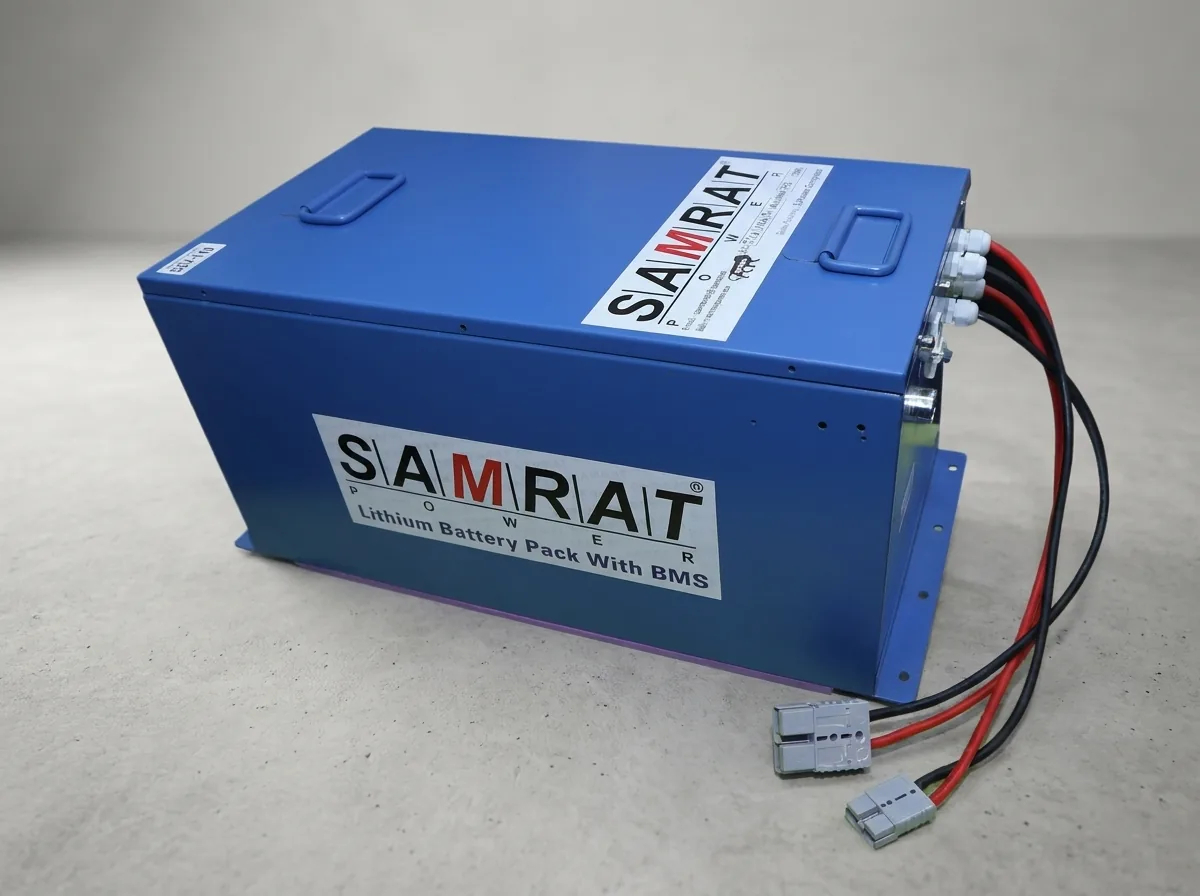
Customized Lithium Battery Pack
Built to your voltage and capacity with a smart BMS, assembled and tested at our New Delhi facility. 36-month warranty.
Price on request
The decision rule
Strip everything above down and you get three questions.
How long will you keep the vehicle? Under two years, lead-acid. Over three, lithium. Between, it depends on the next question.
How many kilometres a day? Under 40, lead-acid is shallow-cycled and lasts long enough that lithium’s advantage shrinks. Over 80, lithium wins clearly and quickly, because you are living in exactly the duty cycle lead-acid handles worst.
Can you use the extra hours? If your route has demand you currently turn away because the battery is flat, the four-hour charge is worth more than every other number on this page combined. If you finish your day at 70 km regardless, it is worth nothing.
For the operator this page was written for — 100 km a day, keeping the vehicle, willing to work a longer day — the answer is lithium, and the sum says it pays back at month 30.
If you want the arithmetic run against your own route, tariff and daily distance rather than ours, send us your numbers and we will work it through with you. We would rather tell you to stay on lead-acid than sell you a pack you will regret.
Frequently asked questions
Is a lithium battery really worth it for an e-rickshaw?
If you are keeping the vehicle for three years or more and running 80 km or more a day, yes. On the assumptions in this guide — 100 km a day, ₹8 per unit electricity, a ₹24,000 lead-acid set replaced every 15 months against a ₹62,000 LFP pack — lithium costs ₹0.79 per kilometre against ₹1.12, and saves about ₹49,000 over five years. Below 40 km a day, or if you are selling the vehicle inside two years, lead-acid is genuinely the better financial choice.
How long does it take for a lithium e-rickshaw battery to pay for itself?
About 30 months on typical commercial usage. The crossover is not gradual: it happens at the point where the lead-acid operator has to buy a third replacement set. Before that, the lithium owner is still behind on cumulative spend — roughly ₹35,000 behind at the end of year one, and about ₹8,000 behind at the end of year two.
Can I use my existing lead-acid charger on a lithium pack?
No, and doing so is the fastest way to ruin a new pack. Lead-acid chargers hold a float voltage that is wrong for lithium and cannot communicate with a BMS. A 16-cell LFP pack (51.2V nominal) needs a charger terminating near 58.4V and a 19-cell pack (60.8V nominal) needs one terminating near 69.4V. Budget for the correct charger as part of the switch.
How many years does an LFP e-rickshaw battery last?
A good LFP pack is rated for around 3,000 cycles to 80% of its original capacity. At 121 km per cycle and 30,000 km a year, that is roughly 1,240 cycles in five years — so the pack has substantial life left at the end of the comparison above. Calendar ageing and heat matter too; five to seven years of daily commercial use is a realistic expectation in Indian conditions.
Why is my lithium quote so much cheaper than another one?
Usually cell grade or BMS. Reclaimed or B-grade cells cut the price by 30–40% and the cycle life by more, because mismatched cell capacity is what kills a pack. The BMS is the other commonly downgraded part — a basic protection board costs a few hundred rupees where a proper smart BMS with balancing, temperature sensing and a low-temperature charge cut-off costs thousands. Ask for cell grade, BMS continuous current rating, and the cycle rating with its capacity threshold attached.
Does lithium save much on electricity?
Less than most people expect. Lithium charges at about 95% round-trip efficiency against roughly 75% for lead-acid, which works out to about ten paise per kilometre — around ₹15,000 over 150,000 km. Real money, but small next to the replacement-cost difference. Energy is not where lithium wins; avoided replacements and recovered hours are.