
Every week someone calls us to say they have a 48 volt battery and want a 48 volt charger, and every week we have to explain that a 48 volt charger will never fill it. It sounds like we are being difficult. We are not — the naming convention for batteries and the naming convention for chargers describe two different things, and once you see the arithmetic the confusion disappears permanently.
This guide gives you the arithmetic, a lookup table for the common Indian pack configurations, a way to choose the current rating, and a short list of the mistakes that destroy packs.
A battery has two voltages, and the label shows the wrong one
A lithium cell has a nominal voltage — roughly the average it sits at through a discharge — and a full-charge voltage, which is higher. Batteries are labelled with the nominal figure because that is what you use to compare packs. Chargers are labelled with the full-charge figure because that is what they must actually deliver.
| Chemistry | Nominal per cell | Full charge per cell | Empty per cell |
|---|---|---|---|
| LFP (LiFePO4) | 3.2 V | 3.65 V | 2.5 V |
| NMC / lithium-ion | 3.6–3.7 V | 4.2 V | 3.0 V |
| Lead-acid (per 12V block) | 12 V | 14.4–14.7 V | 10.5 V |
An LFP cell at full charge is 14% above its nominal voltage. String sixteen of them in series and that 14% becomes 7.2 volts of difference between the label and what the charger has to produce.
Charger output voltage = number of cells in series × full-charge voltage per cell.
For LFP: cells × 3.65 V. For NMC: cells × 4.2 V.
So a 16-cell LFP pack: 16 × 3.65 = 58.4 V. That is why the charger says 58V. The pack says 51.2V (16 × 3.2) and gets rounded to “48V” in the market because it replaces a 48V lead-acid set. Three different numbers, all describing the same battery.
The lookup table
Find your pack in the left column. The charger you need is on the right.
| Cells in series | Chemistry | Nominal (label) | Sold as | Charger must terminate at |
|---|---|---|---|---|
| 13S | NMC | 48.1 V | “48V” | 54.6 V |
| 16S | LFP | 51.2 V | “48V” | 58.4 V |
| 16S | NMC | 59.2 V | “60V” | 67.2 V |
| 19S | LFP | 60.8 V | “60V” | 69.4 V |
| 20S | LFP | 64 V | “64V” | 73.0 V |
| 20S | NMC | 74 V | “72V” | 84.0 V |
| 23S | LFP | 73.6 V | “72V” | 84.0 V |
Two rows in that table are the reason our charger range is named the way it is. A 16S LFP pack needs 58.4 V, so we build a 58V · 25A charger. A 19S LFP pack needs 69.4 V, so we build a 69V · 22A charger. If you have been sent here because you asked for a “48V lithium charger”, the 58V unit is what you want.
A 23S LFP pack and a 20S NMC pack both terminate at 84.0 V, but they are not interchangeable on the same charger. The termination voltage matches; the discharge curve, the empty-voltage floor and the BMS behaviour do not. Match the chemistry as well as the number.
Choosing the current rating
Voltage decides whether the charger works at all. Current decides how long it takes and how hard it is on the pack.
The useful unit here is C-rate — charging current divided by pack capacity in amp-hours. A 25 A charger on a 100 Ah pack is 0.25C. A 50 A charger on the same pack is 0.5C.
| C-rate | 100 Ah pack | Rough time to full | Trade-off |
|---|---|---|---|
| 0.1C | 10 A | 11–12 hours | Gentlest on the cells; too slow for commercial use |
| 0.2C | 20 A | 6–6.5 hours | Good overnight balance |
| 0.25C | 25 A | 5 hours | Our usual recommendation for LFP traction packs |
| 0.5C | 50 A | 2.5–3 hours | Noticeably more heat; needs a pack and BMS rated for it |
| 1C | 100 A | ~1.2 hours | Only for cells explicitly rated for it; shortens life otherwise |
Those times are not simply capacity divided by current, and it is worth knowing why. Charging happens in two phases. In constant current the charger pushes its full rated amps and the pack voltage climbs; this takes the pack to roughly 80–90%. Then the charger hits its termination voltage and switches to constant voltage, holding that voltage while the current tapers away. That last 10–20% takes a disproportionate amount of time — typically 45 to 60 minutes regardless of how big the charger is.
So a 100 Ah pack on a 25 A charger is about four hours of constant current plus roughly an hour of taper: five hours, not four. Doubling the charger to 50 A halves the first phase but not the second, which is why the jump from 0.25C to 0.5C buys you less than you would expect while costing considerably more in heat.
For an LFP traction pack in daily commercial service, size the charger between 0.2C and 0.3C. That fills the pack inside a normal break or overnight window without the thermal penalty of fast charging, and it is the range where LFP cycle life is at its best.
What actually happens when the charger is wrong
These are the four failures we see, in order of how often they walk through our door.
Too low a voltage: the pack never fills
Put a genuine 48.0 V charger on a 16S LFP pack and it will charge to about 82% and stop. Nothing breaks, but the owner concludes the battery is faulty and the range is poor. This is the most common and least damaging error, and it is nearly always the result of buying a charger by the pack’s marketing name.
Too high a voltage: cells go over-voltage
Put a 20S NMC charger (84 V) on a 19S LFP pack (69.4 V) and every cell is driven far past 3.65 V. A good BMS will disconnect and save the pack. A cheap BMS will not, and LFP cells held above about 3.8 V degrade quickly and can vent. This is the error that starts fires, and it usually happens when someone borrows a charger that “fits the socket”.
A lead-acid charger on a lithium pack: the slow kill
This one is subtle, because the numbers look close. A 48 V lead-acid charger terminates around 57.6–58.8 V, which is genuinely near the 58.4 V an LFP pack wants. People try it, it appears to work, and they tell their friends.
The damage comes afterwards. A lead-acid charger does not stop — it drops to a float voltage and holds the battery there indefinitely, because that is correct for lead-acid and actively harmful for lithium. Lithium cells left sitting at full charge age faster, and an LFP pack held at float will lose capacity measurably over a few months. Many lead-acid chargers also apply desulphation pulses, deliberate short high-voltage spikes that have no meaning for a lithium cell and which the BMS has to absorb.
Too much current: heat you cannot see
An oversized charger on a pack whose BMS cannot handle the current will either trip repeatedly or, worse, run at the limit and heat the cells. Charging heat is the enemy of cycle life. If the pack is warm to the touch at the end of a charge in a Delhi summer, the charger is too big for it.
Matching our chargers to packs
For readers who are here to buy rather than to calculate:
| Charger | Output | Intended pack | Time for 100 Ah | Price |
|---|---|---|---|---|
| 58V · 25A Lithium | 58.4 V, 25 A | 16S LFP, sold as “48V lithium” | About 5 hours | ₹5,250 |
| 69V · 22A Lithium | 69.4 V, 22 A | 19S LFP, sold as “60V lithium” | About 5.5 hours | ₹5,460 |
| 48V · 18A | 48 V system, 18 A | 48 V e-rickshaw packs, auto cut-off | Depends on pack | ₹4,200 |
| 1500 Volt EV Charger | High-output, aluminium body | Heavy-duty e-rickshaw and e-cart packs | Depends on pack | ₹6,300 |
The 58V and 69V units are SMPS-based and carry charge-level indicators on the case, so the operator can see progress without guessing. If your pack is not 16S or 19S LFP, tell us the cell count and chemistry before ordering — we would rather redirect you than sell you the wrong unit.
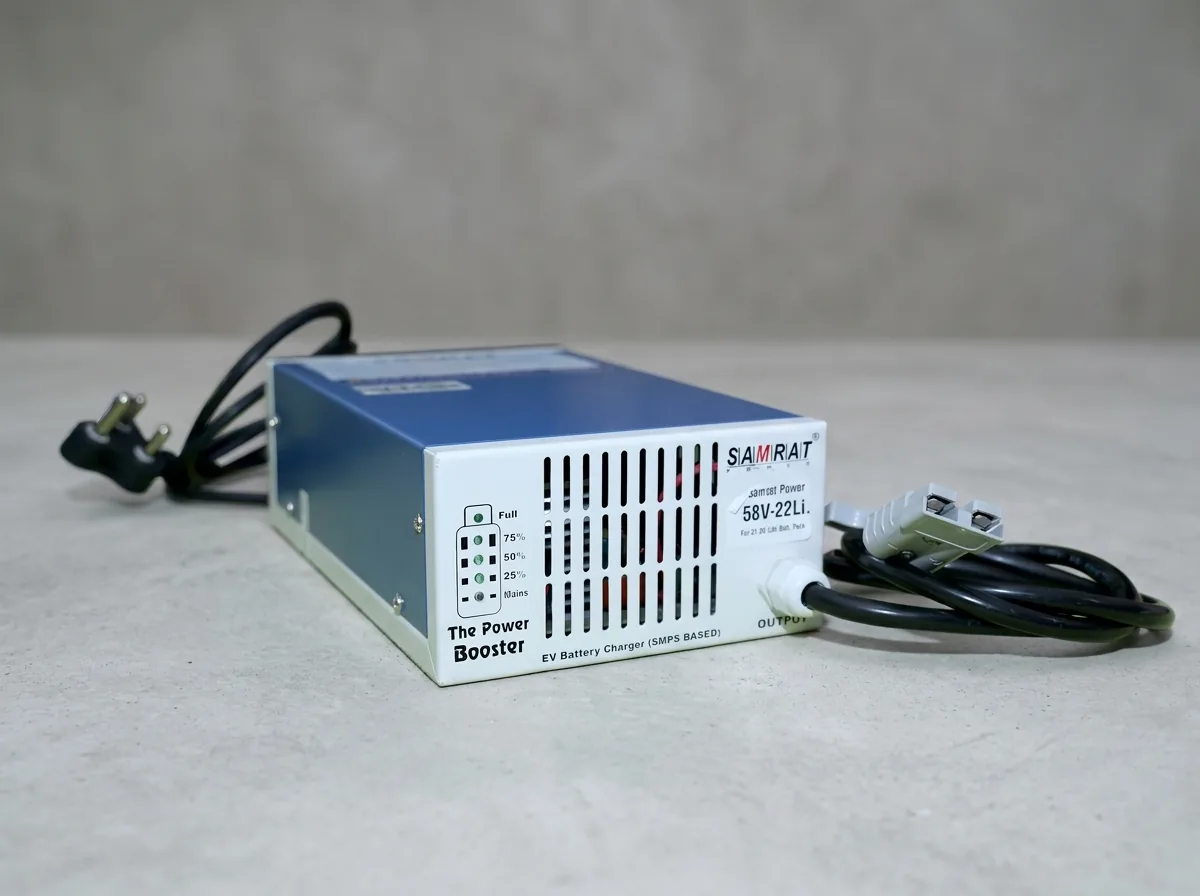
58V · 25A Lithium EV Charger
The correct charger for a 16-cell LFP pack — the one sold everywhere as “48V lithium”. SMPS control, charge-level LEDs, 12-month warranty.
₹5,250 incl. GST
SMPS or transformer?
You will still find both on the market, and the price gap is large enough that it is worth understanding what you are giving up.
A transformer charger uses a heavy iron-cored transformer to step mains voltage down, then rectifies it. It is simple, robust, repairable by any workshop, and cheap. It is also heavy, inefficient — typically 70–80% — and crude in its regulation: output voltage moves with mains voltage, which in much of India moves a great deal. On a lead-acid battery that sloppiness is tolerable. On lithium, where the termination voltage needs to be held within a fraction of a volt, it is not.
An SMPS (switch-mode) charger converts at high frequency, which lets it use a small transformer and hold its output under closed-loop control. Efficiency is typically 88–93%, regulation is tight regardless of what the mains is doing, and the constant-current and constant-voltage phases can be properly controlled. Our 58V and 69V lithium chargers are both SMPS-based for exactly this reason.
The efficiency difference is not trivial over a working life. Charging a 5 kWh pack daily, the gap between 75% and 90% efficiency is about 1.1 kWh per day — roughly ₹2,600 a year at ₹8 a unit. The better charger pays for its own price difference in well under a year, before considering what tight voltage regulation is worth to the pack.
When the charger seems to be failing
Four symptoms account for most of the chargers that come back to us, and two of them are not charger faults at all.
| Symptom | Usual cause | What to check first |
|---|---|---|
| Charging stops after a few minutes | BMS tripping, not the charger | Cell balance and pack temperature. A single cell hitting its over-voltage limit early will stop the whole charge. |
| Pack never reaches full | Wrong charger voltage, or a weak cell | Confirm the charger’s termination voltage matches cell count × 3.65 V. If it does, suspect a cell. |
| Charger very hot, fan loud | Blocked airflow or ambient heat | Where it is being used. Charging in a closed box in May will do this to any charger. |
| Takes far longer than it used to | Ageing pack, or mains voltage sag | Measure mains voltage while charging. A supply sagging to 180 V will make any charger derate. |
The first row is the one worth internalising: most reported charger faults are battery faults. The charger is the visible thing with a fan and lights, so it takes the blame. Before replacing a charger, put a meter on the pack and confirm what voltage it actually reaches.
Buying checklist
Before you order anything, you should be able to answer all five of these. If you cannot, ask whoever built the pack — and if they cannot answer either, that tells you something about the pack.
How many cells in series?
This is the only number that determines charger voltage. It is usually written on the BMS or in the pack’s documentation as 16S, 19S, 23S and so on. Everything else is derived from it.
What chemistry?
LFP or NMC. Multiply by 3.65 or 4.2 accordingly. Getting this wrong on the same cell count is a 15% voltage error — enough to either undercharge badly or over-voltage every cell.
What capacity, in amp-hours?
Divide your intended charger current by this to get the C-rate. Aim for 0.2C to 0.3C.
What is the BMS rated to accept on charge?
Separate from its discharge rating, and usually lower. A charger that exceeds it will trip the BMS repeatedly.
What connector?
Mundane, and the reason for more failed deliveries than every electrical question combined. Photograph the existing connector and send the picture.
Getting the most out of the charger you buy
A few habits materially extend both charger and pack life, and none of them cost anything.
- Give it air. These units are convection or fan cooled. Charging inside a closed box or under a seat cover in May will shorten the charger’s life before it shortens the battery’s.
- Do not charge a pack that is below freezing. Charging LFP below 0 °C plates metallic lithium onto the anode and causes permanent, cumulative damage. In most of India this rarely arises, but a January night in the north can get there. A good BMS blocks it; do not rely on that.
- Unplug when it is done. A correctly designed lithium charger stops on its own, but leaving a pack on charge for days is unnecessary and holds the cells at their most stressed state.
- Do not charge immediately after a hard run. Give the pack twenty minutes to shed heat. Charging a hot pack compounds thermal stress.
- Listen to it. A fan that has started rattling is a fan that is about to stop, and a charger whose fan has stopped will cook itself.
For the full picture on charging habits and what they do to pack life, see our guide to charging practice and battery lifespan.
In one paragraph
Batteries are labelled with nominal voltage, chargers with full-charge voltage, and the gap between them is about 14% for LFP and 17% for NMC. Multiply your series cell count by 3.65 for LFP or 4.2 for NMC and you have the charger voltage you need. Then divide your intended charging current by the pack’s amp-hour rating and keep the answer between 0.2 and 0.3. Get those two numbers right and almost nothing else about charging can go badly wrong.
Frequently asked questions
Why does my 48V lithium battery need a 58V charger?
Because “48V” is the pack’s marketing name, not its charging voltage. A 16-cell LFP pack is 51.2V nominal and each cell charges to 3.65V, so the charger must deliver 16 × 3.65 = 58.4V to fill it. A charger that actually outputs 48V will only take the pack to around 82% and the owner will wrongly conclude the battery is faulty.
Can I charge a lithium battery with a lead-acid charger?
No. The termination voltages look close — a 48V lead-acid charger stops around 57.6–58.8V against the 58.4V an LFP pack wants — which is why people try it. The problem is what happens next: a lead-acid charger drops to a float voltage and holds the battery there indefinitely, which ages lithium cells quickly. Many also apply desulphation pulses that are meaningless to lithium and have to be absorbed by the BMS.
How do I work out what charger voltage I need?
Multiply the number of cells in series by the full-charge voltage of the chemistry: 3.65V per cell for LFP, 4.2V per cell for NMC. A 19S LFP pack needs 19 × 3.65 = 69.4V. A 20S NMC pack needs 20 × 4.2 = 84V. The cell count is normally marked on the BMS or in the pack documentation.
How many amps should my charger be?
Between 0.2 and 0.3 times the pack capacity in amp-hours. For a 100Ah pack that is 20 to 30 amps, which fills it in roughly five to six hours. Going higher works if the cells and BMS are rated for it, but the gain is smaller than expected because the final constant-voltage taper takes 45 to 60 minutes no matter how large the charger is.
Why does the last 10% take so long to charge?
Charging has two phases. Constant current takes the pack to about 80–90% at the charger’s full rated amps. After that the charger holds its termination voltage and lets the current fall away by itself, which is what safely tops up the cells and lets the BMS balance them. That taper takes 45 to 60 minutes and is largely independent of charger size.
Is it safe to leave the battery on charge overnight?
With a properly designed lithium charger, yes — it terminates and stops rather than floating. It is still better to unplug once charging finishes, because holding cells at full charge is their most stressed state. Never leave a lead-acid charger connected to a lithium pack overnight, as it will float the pack indefinitely.