
If you ask a driver why they moved to a 60 volt rickshaw, they will not say anything about electrical engineering. They will say it pulls better with four passengers, it does not struggle on the flyover, and the controller stopped getting hot.
All three of those are the same physical fact seen from three angles. This guide explains what that fact is, what a 60 V lithium pack actually consists of, what range to expect, and where 60 V stops being the right answer.
The one idea that explains everything else
Electrical power is voltage multiplied by current. If a motor needs 1,200 W, it can get there as 51.2 V × 23.4 A, or as 60.8 V × 19.7 A. Same power, same work done, but the second option moves 16% less current through the system.
That matters because almost everything that goes wrong in an e-rickshaw electrical system is caused by current, not voltage. Resistive heating rises with the square of current: cut current by 16% and you cut heating losses by about 29%. That heat was being generated in your cables, your connectors, your controller MOSFETs and inside the cells themselves.
| 16S LFP (51.2 V) | 19S LFP (60.8 V) | Change | |
|---|---|---|---|
| Cruising current | 23.4 A | 19.7 A | −16% |
| Peak current under load | ~60 A | ~50 A | −16% |
| Relative resistive loss | 100% | 71% | −29% |
| Voltage sag under a hard pull | Higher | Lower | Better torque |
The last row is what the driver actually feels. Every pack sags — its terminal voltage drops momentarily when a large current is drawn, because of internal resistance. On a 51.2 V pack pulling 60 A, that sag might take the pack to 47 V, a 9% loss right at the moment the vehicle needs power most. The same pack chemistry at 19S drawing 50 A sags proportionally less and from a higher starting point. The motor sees more voltage exactly when it is working hardest, and delivers more torque.
Going from 48V to 60V does not give you a more powerful motor. It gives the motor you already have a cleaner supply under load, and stops the rest of the system cooking itself. Both effects are largest precisely when the vehicle is fully loaded — which is when it is earning.
What a 60V lithium pack is made of
Nineteen LFP cells in series — 19S. At 3.2 V nominal per cell that is 60.8 V nominal, which is why you will see the same pack advertised as 60V, 60.8V, 61V and 19S.
| State | Per cell | Whole pack | Consequence |
|---|---|---|---|
| Fully charged | 3.65 V | 69.4 V | The charger must reach this |
| Nominal | 3.20 V | 60.8 V | The number on the label |
| Fully discharged | 2.50 V | 47.5 V | BMS disconnect point |
Hence the 69V · 22A lithium charger — the number on a charger is the full-charge voltage, not the nominal one. If that still feels strange, the charger matching guide derives it from first principles.
Note also that a fully discharged 19S pack sits at 47.5 V — higher than a fully charged 13S NMC pack. Voltage alone tells you nothing about state of charge unless you know the cell count and chemistry, which is why a voltmeter is a poor fuel gauge on a lithium system.
Range, honestly
The advertised range figures in this market are optimistic, and it is worth being clear about why before quoting any. Manufacturers quote a light vehicle, a single rider, flat ground and steady speed — conditions no commercial e-rickshaw ever meets.
Working figures for a loaded three-wheeler are 40–55 Wh per kilometre. We plan on 45.
| Capacity | Nameplate | Usable | Realistic range | Charge time at 22 A |
|---|---|---|---|---|
| 60.8V 60Ah | 3.65 kWh | 3.28 kWh | ~73 km | ~3.5 hours |
| 60.8V 80Ah | 4.86 kWh | 4.38 kWh | ~97 km | ~4.5 hours |
| 60.8V 100Ah | 6.08 kWh | 5.47 kWh | ~122 km | ~5.5 hours |
| 60.8V 120Ah | 7.30 kWh | 6.57 kWh | ~146 km | ~6.5 hours |
| 60.8V 150Ah | 9.12 kWh | 8.21 kWh | ~182 km | ~8 hours |
Read those as ceilings for a healthy pack in reasonable weather, then subtract for reality: a July afternoon with four passengers and a route full of signals will take 15–20% off. A pack at the end of its warranted life will be at 80% of rated capacity, taking another fifth off. Size for the bad day, not the good one.
The 100 Ah row is where most commercial single-vehicle operators land, and the reason is the interaction between range and charge time rather than range alone. It covers a 100 km day with margin, and it refills in about five and a half hours — which fits an overnight window comfortably, or a long afternoon break at partial charge.
60V against 48V, directly
| 16S — 51.2V 100Ah | 19S — 60.8V 100Ah | |
|---|---|---|
| Usable energy | 4.61 kWh | 5.47 kWh |
| Realistic range | ~102 km | ~122 km |
| Cruising current, 1,200 W motor | 23.4 A | 19.7 A |
| Cells in the pack | 16 | 19 |
| Approximate weight | ~42 kg | ~50 kg |
| Matching charger | 58V · 25A | 69V · 22A |
| Typical price difference | Baseline | 15–20% more |
Adding three cells in series buys you 19% more energy and 16% less current, for 15–20% more money and 8 kg. On any vehicle that carries real loads, that is a straightforwardly good trade.
The one thing it does not buy you is compatibility. A 60 V pack on a vehicle wired and wound for 48 V is not an upgrade — it is an over-voltage. The controller may tolerate it, may go into protection, or may fail outright, and the motor will run outside its design envelope. Converting a 48 V vehicle to 60 V means changing the controller and confirming the motor can take it. That is a workshop job, not a battery swap.
Check the controller’s rated input range before anything else. Most 48 V e-rickshaw controllers are specified to around 60 V absolute maximum — and a fully charged 19S pack is 69.4 V, comfortably past it. If you want 60 V on an existing 48 V vehicle, budget for a matched controller at the same time.
What a working day looks like electrically
Specifications describe steady states. A rickshaw never operates in one. It is worth walking through a real day, because it explains which specifications actually matter and which are marketing.
Morning, full pack
The pack comes off charge at 69.4 V and settles to about 67 V within a few minutes as the surface charge dissipates. Nothing is wrong; this is normal and every lithium pack does it. Drivers who watch a voltmeter often think the pack is losing charge on the stand.
Pulling away, loaded
This is the hardest moment of the day, repeated several hundred times. The motor demands peak current — 45–55 A on a 19S system with four passengers — for one to three seconds. Pack voltage sags, recovers as the vehicle gets moving, and the cycle repeats at the next signal. Over a day this is a few hundred high-current pulses, and it is the duty that separates a pack built for traction from a pack built for solar storage.
Mid-afternoon, hot
Ambient 43 °C, pack internal temperature perhaps 50 °C after hours of cycling. LFP tolerates this far better than NMC does, which is the main reason it dominates Indian commercial three-wheelers, but capacity and cycle life still suffer at sustained high temperature. Ventilation around the pack matters more than most people think, and a pack packed tightly into an unventilated steel box will run measurably hotter than one with air around it.
Evening, the flat part of the curve
Between roughly 90% and 20% state of charge, a 19S LFP pack sits between about 64 V and 61 V — three volts across seventy percent of its usable energy. This is why voltage-based fuel gauges are so poor on LFP, and why a proper BMS with coulomb counting is worth paying for. Without one, the driver’s first reliable warning is the pack falling off the end of the curve, which arrives suddenly.
Night, on charge
Constant current at 22 A for four and a half hours or so, then the taper. The balancing happens in the taper: the BMS bleeds charge off cells that reach 3.65 V early so the rest can catch up. Cutting the charge short every night to save an hour means the pack never balances, and an unbalanced pack loses usable capacity steadily. Let it finish at least once a week.
What the BMS has to handle at 60V
Lower current is easier on the BMS, but the requirements do not disappear. For a 19S commercial traction pack we specify:
- 50–60 A continuous discharge, with headroom for 100 A+ momentary. Note again that this is the continuous figure, which is often a third of the number on the marketing sticker.
- Per-cell monitoring on all nineteen cells. Some cheap boards monitor groups rather than individual cells, which means a single weak cell is invisible until it fails.
- Balancing. More cells in series means more opportunity for drift. Nineteen cells need active attention; a balancing current under about 50 mA will not keep up with a hard-worked pack.
- At least two temperature sensors, positioned in the cell stack rather than on the board.
- Low-temperature charge cut-off. Charging LFP below 0 °C causes permanent damage. In north Indian winters this is a real scenario, not a theoretical one.
Our BMS guide goes into what each of these does and how to tell a genuine smart BMS from a protection board with a Bluetooth chip glued on.
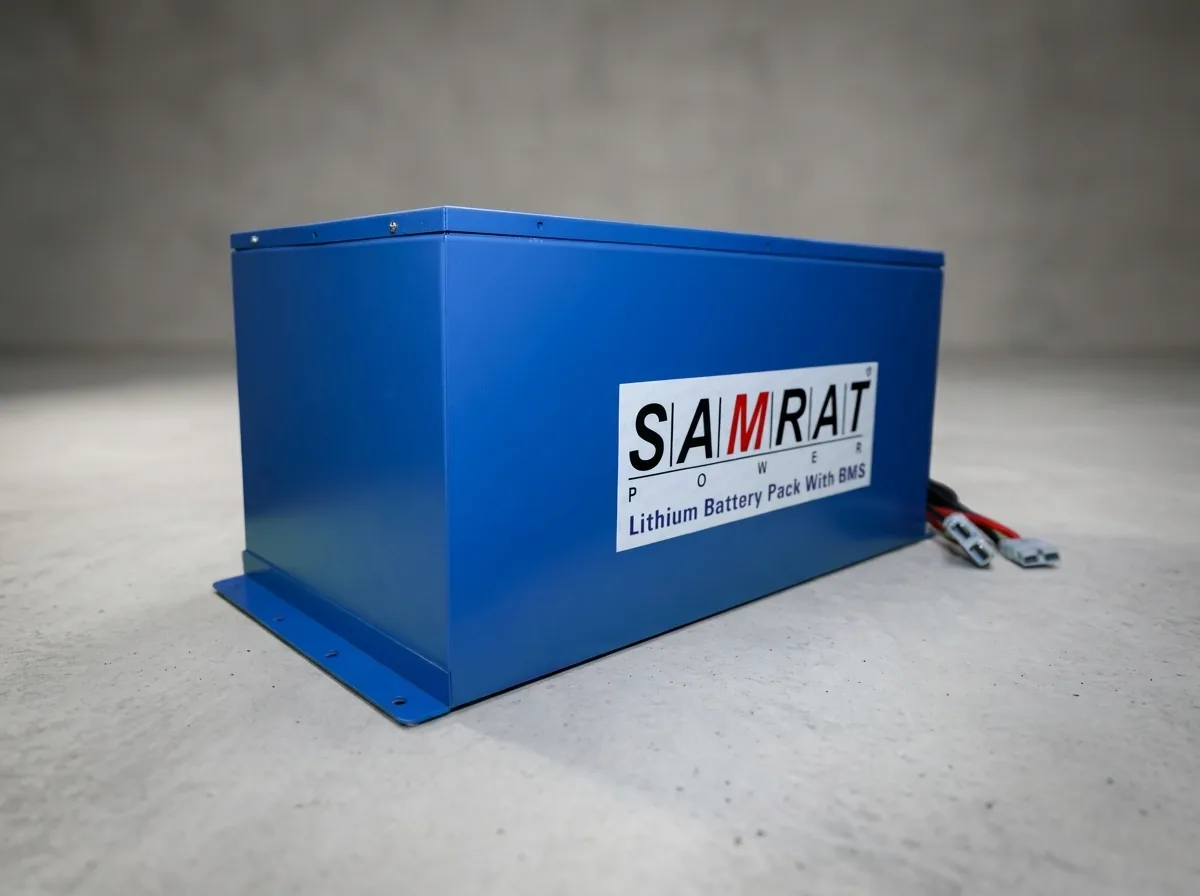
Customized Lithium Battery Pack
19S LFP packs built to your capacity, tray dimensions and connector, with a BMS specified for commercial e-rickshaw duty. Made and tested in New Delhi since 1994.
Price on request
The fleet argument
For anyone running more than a handful of vehicles, 60 V changes the arithmetic in a way that is easy to miss when looking at a single rickshaw.
Charging infrastructure is sized by current, not energy. A depot charging twenty 48 V vehicles at 25 A each is handling 500 A of DC across its chargers; the same twenty vehicles at 60 V and 22 A is 440 A for more delivered energy. Over a depot’s worth of cabling, breakers and connectors, that difference is real money and real heat.
Second, standardising on one voltage across a mixed fleet removes an entire category of error. The most common expensive mistake in a multi-vehicle operation is a driver plugging a 60 V pack into a 58 V charger, or worse the reverse. One voltage, one charger type, one spare pack that fits everything.
Third, uptime. A 100 Ah 19S pack covers a 120 km day, which for most urban operations means one charge per vehicle per night and no midday shuffling of vehicles between charging points. We cover depot design and swap-versus-charge economics in our guide to EV fleet battery management.
Specifying your pack
Send us these six things and we can quote accurately:
Confirm the vehicle is a 60V system
Five 12 V batteries originally, or a controller marked 60 V. If you are converting from 48 V, say so — the controller has to change too.
Your longest realistic day
In kilometres, on the worst route you actually run. Not the average, and not the best case.
Motor rating and controller current limit
These set the BMS continuous rating. If you do not know them, a photograph of the controller label usually has both.
Tray dimensions in millimetres
Length, width and height of the available space. This constrains capacity more often than budget does, and it is the single most common cause of a pack that has to be rebuilt.
Charging window
How many hours the vehicle stands still. This sets the charger current, and there is no point buying a 22 A charger for a vehicle that sits for eleven hours.
Connector photograph
Both the pack side and the charger side.
If you are choosing between 48 V and 60 V and the vehicle could take either, tell us the daily distance and typical load and we will tell you which one we would fit. Over about 100 km a day, or with consistently full loads, the answer is nearly always 60.
Frequently asked questions
What is a 60V lithium battery in an e-rickshaw?
Nineteen LFP cells in series — 19S — giving 60.8V nominal, 69.4V fully charged and 47.5V fully discharged. You will see the same pack sold as 60V, 60.8V, 61V or 19S; they all describe the same thing. It needs a charger rated around 69V, not 60V.
Is 60V better than 48V for an e-rickshaw?
For loaded commercial work, yes. The same motor power at 60V draws roughly 16% less current, which cuts resistive heating by about 29% and reduces voltage sag under hard acceleration — that is what drivers feel as better pull with a full load. It also means a cooler controller and cooler cabling. Below about 90km a day with moderate loads, 48V is perfectly adequate and cheaper.
Can I fit a 60V lithium battery to my 48V e-rickshaw?
Not without changing the controller. A fully charged 19S pack sits at 69.4V, and most 48V e-rickshaw controllers are rated to around 60V absolute maximum. Fitting one risks the controller going into protection or failing outright, and runs the motor outside its design envelope. Converting from 48V to 60V is a workshop job involving a matched controller, not a straight battery swap.
How far does a 60V 100Ah lithium battery go?
About 122km on a moderate load in reasonable weather — 6.08kWh nameplate, 5.47kWh usable at 90% depth of discharge, at roughly 45Wh per kilometre. Subtract 15–20% for a fully loaded vehicle in peak summer on a stop-start route, and expect a further reduction as the pack approaches the end of its rated cycle life at 80% capacity.
Why does a 60V pack need a 69V charger?
Because the charger has to reach the pack’s full-charge voltage, not its nominal one. Nineteen LFP cells at 3.65V each is 69.4V. A charger that genuinely outputs 60V would only fill the pack to about 80% and the owner would wrongly conclude the battery was faulty.
What BMS current rating do I need for a 60V e-rickshaw pack?
50 to 60A continuous, with headroom for momentary peaks above 100A. The important word is continuous — a BMS marketed as “120A” is frequently 120A peak and only 40–50A continuous, which will trip repeatedly in daily service. Also insist on per-cell monitoring across all nineteen cells rather than group monitoring.