
When a lithium pack fails early, the conversation almost always starts with the cells. Were they A-grade? Were they genuine? Occasionally that is the answer. More often the cells were fine and the pack was killed by the thing managing them.
A battery management system does four jobs: it protects the cells from conditions that damage them, it keeps them equal to one another, it measures what is going on, and it reports it. Cheap boards do the first job partially and the other three not at all — and because a pack with a bad BMS works perfectly for the first six months, nobody discovers the difference until the warranty conversation.
This guide explains each function, why it matters in physical terms, and exactly what to ask before you buy.
Why cells cannot be left alone
A lead-acid battery is forgiving. Overcharge it a little and it gasses, loses water, and carries on. The chemistry has a natural safety valve.
Lithium has none. Push a cell above roughly 3.65 V (LFP) or 4.2 V (NMC) and the electrolyte begins to decompose, gas builds inside a sealed can, and the damage is permanent. Pull it below about 2.5 V and the copper current collector starts to dissolve, which later plates out as internal shorts. Neither condition announces itself. A cell that has been overcharged looks exactly like one that has not, until it fails.
Now put nineteen of those cells in series. They carry identical current — series circuits have no choice about that — but they do not have identical capacity. Manufacturing tolerance, temperature differences across the pack and uneven ageing mean one cell always fills first and empties first.
A series string can only be charged until its strongest cell is full, and only discharged until its weakest cell is empty — so the whole pack behaves like its worst cell, and the gap widens with every cycle unless something actively closes it.
That is the entire reason a BMS exists. Without one, a 19-cell pack is nineteen individual risks wired together, and its usable capacity shrinks every month.
The protections, and what each one prevents
| Protection | Triggers when | What it prevents | How bad if missing |
|---|---|---|---|
| Cell over-voltage | Any cell exceeds 3.65 V (LFP) | Electrolyte breakdown, gassing, venting | Severe — fire risk |
| Cell under-voltage | Any cell falls below ~2.5 V | Copper dissolution and later internal shorts | Severe — kills the cell |
| Over-current, discharge | Draw exceeds the rating | Cell heating, MOSFET failure | High |
| Short circuit | Microseconds after a dead short | Catastrophic current, arc, fire | Critical |
| Over-temperature | Cells exceed ~55–60 °C | Accelerated ageing, runaway risk | High |
| Low-temperature charging | Charging below 0 °C | Lithium plating on the anode | High — permanent, cumulative |
| Over-current, charge | Charger or regen exceeds limits | Plating and heating | Moderate to high |
Almost every board on the market claims the first four. The last three are where the corners get cut, and they are the three that matter most in Indian conditions.
Low-temperature charge cut-off deserves particular attention. Charging a lithium cell below freezing deposits metallic lithium on the anode rather than storing it in the graphite. That deposit does not go away. It accumulates cycle by cycle, permanently reducing capacity and eventually growing dendrites that pierce the separator and short the cell internally. A vehicle parked outside on a January night in Delhi, Punjab or Haryana can easily be below zero at 6 am when the owner plugs it in. A board without this protection will charge it happily.
Balancing: the function that decides pack life
Protection stops disasters. Balancing determines whether the pack is still worth using in year four.
Over cycles, cells drift apart. Say cell 7 is 2% lower in capacity than the rest — entirely normal manufacturing variation. On charge, cell 7 reaches 3.65 V while the others are at 3.58 V. The BMS must stop charging, because continuing would over-charge cell 7. The pack is now “full” with most of its cells slightly short. On discharge, cell 7 empties first and the BMS cuts off with energy still in the others.
Left alone, that gap widens: the weak cell is worked hardest at both ends of every cycle, so it degrades faster, so the gap grows. This is a runaway process, and it is how packs lose a third of their capacity in two years while every cell remains technically healthy.
Passive balancing
The common approach. When a cell runs ahead, a resistor bleeds a small current off it as heat until the others catch up. Simple, cheap, reliable. The limitation is speed: balancing currents are typically 30–150 mA, and it only works during the constant-voltage phase at the top of a charge.
That last point has a practical consequence most owners never hear. Balancing only happens at the end of a full charge. A pack that is habitually charged to 80% and unplugged never balances at all. If you do short top-ups all week, let the pack run to a genuine full charge at least weekly so the BMS gets a chance to work.
Active balancing
Instead of burning excess energy from the strong cell, an active balancer moves it to the weak one. It is more efficient, works across a wider range of states of charge, and can shift far more current — often 1–5 A. It is also several times the cost and more complex.
For most traction packs built from well-matched cells, good passive balancing is sufficient and is what we fit as standard. Active balancing earns its price on large packs, on packs assembled from cells with a wider capacity spread, and on stationary storage that rarely sees a full charge.
“What is the balancing current?” A board that balances at 30 mA on a 100 Ah pack is moving 0.03% of capacity per hour — it will never catch a cell that has drifted meaningfully. For a 100 Ah traction pack, look for at least 100 mA passive, and be sceptical of any supplier who does not know the number.
Reading the current ratings honestly
This is where most buyers are misled, and it is rarely a lie — just a number quoted without its qualifier.
A BMS advertised as “100 A” is usually 100 A peak, for a few seconds, at 25 °C ambient. Its continuous rating might be 40 A, and at 45 °C in a sealed enclosure it will be lower still, because the MOSFETs that carry the current derate as they heat.
| Application | Continuous discharge needed | Peak needed | Notes |
|---|---|---|---|
| E-rickshaw, 48V | 60 A | 120 A+ | Frequent short high-current pulls from standstill |
| E-rickshaw, 60V | 50–60 A | 100 A+ | Lower current for the same power |
| E-loader, 72V | 60–80 A | 150 A+ | Sustained draw on gradients is the binding case |
| E-scooter | 30–50 A | 80 A+ | Add charge-side headroom if regen is fitted |
| Home inverter / solar | Match the inverter’s peak VA | 2–3× continuous | Motor loads surge heavily at startup |
Ask for the continuous rating, ask at what ambient temperature it was measured, and ask what the charge-side rating is — it is usually lower than the discharge rating and it is what regenerative braking has to work within.
What makes a BMS “smart”
The word gets attached to any board with a Bluetooth module. A genuinely smart BMS does three things a protection board cannot.
It counts coulombs
Rather than guessing state of charge from voltage — hopeless on LFP’s flat curve — it integrates current in and out over time to produce a real percentage. This is the difference between a fuel gauge and a decoration.
It monitors every cell individually
Some cheaper boards monitor parallel groups rather than individual cells, so a single failing cell inside a group is invisible until the group as a whole sags. On a 19S pack you want nineteen voltage readings.
It keeps history
Cycle count, temperature extremes, over-current events, cell voltage spread over time. This is what turns a warranty conversation from an argument into a diagnosis — and it tells you whether a pack that is misbehaving was abused or is genuinely faulty.
Communication over Bluetooth, UART or CAN is how you get at all this. It is a means, not the feature itself.
How it is wired, and why that matters
One structural choice affects what the BMS can do, and it is worth knowing which one you have.
In a common-port design, charge and discharge share the same pair of terminals and the same set of MOSFETs. It is simpler, cheaper and smaller, and it is what most low-cost boards use. The limitation is that charge and discharge cannot be limited independently — the board sees current in one direction or the other through the same hardware.
In a separate-port design, charging and discharging have their own paths and their own MOSFETs. This allows different current limits for each, which matters in two common situations: a vehicle with regenerative braking, where charge current arrives unpredictably and needs its own ceiling, and a pack that discharges at 60 A but should never be charged above 25 A. It also means a fault on the charge side does not disable discharge, so a vehicle whose charging circuit has tripped can still be driven home.
For an e-rickshaw with no regen and a matched charger, common-port is perfectly adequate. For a loader with regenerative braking, or any pack where the safe charge rate is well below the discharge rate, separate ports are the right choice and worth specifying explicitly.
How to spot a downgraded BMS
You will rarely see the board before you buy. These questions get you the answer anyway, and how they are answered tells you as much as the answers themselves.
- “What is the continuous discharge rating, and at what ambient?” A vague answer, or a peak figure offered instead, is the most reliable warning sign there is.
- “Does it monitor each cell or groups of cells?”
- “What is the balancing current?”
- “How many temperature sensors, and where are they?” Sensors on the board tell you about the board. You want them in the cell stack.
- “Does it block charging below 0 °C?”
- “What is the standby current draw?” Relevant for a vehicle parked for weeks. A board drawing 30 mA continuously will flatten a pack over a long layup; a good one draws well under 1 mA in sleep.
- “Separate charge and discharge ports, or common port?” Separate-port designs allow different current limits for charge and discharge, which matters for regen and fast charging.
On a ₹60,000 pack, the difference between a basic protection board and a proper smart BMS is a few thousand rupees — single-digit percent of the pack. The difference in outcome is often two or three years of service life. It is the worst place in the entire build to save money, and the first place a low quote has saved it.
What a BMS will not do
Worth being clear, because expectations here cause real damage.
It will not fix bad cells. Balancing manages small differences. Cells that are genuinely mismatched — reclaimed cells of unknown history, for instance — will drift faster than any balancer can correct.
It is not a routine cut-off device. The BMS is a last line of defence. If your vehicle controller’s low-voltage cut-off is set for lead-acid, the BMS ends up performing the cut-off on every discharge, and repeatedly slamming a protection circuit into action is hard on it. Set the controller correctly and let the BMS be the backstop it was designed to be.
It will not save a pack from a wrong charger. It will disconnect, repeatedly, and the owner will conclude the battery is faulty. Get the charger right — see the charger matching guide.
It cannot cool the pack. It can shut things down when the pack is too hot, but thermal management is a matter of enclosure design, ventilation and current, not electronics.
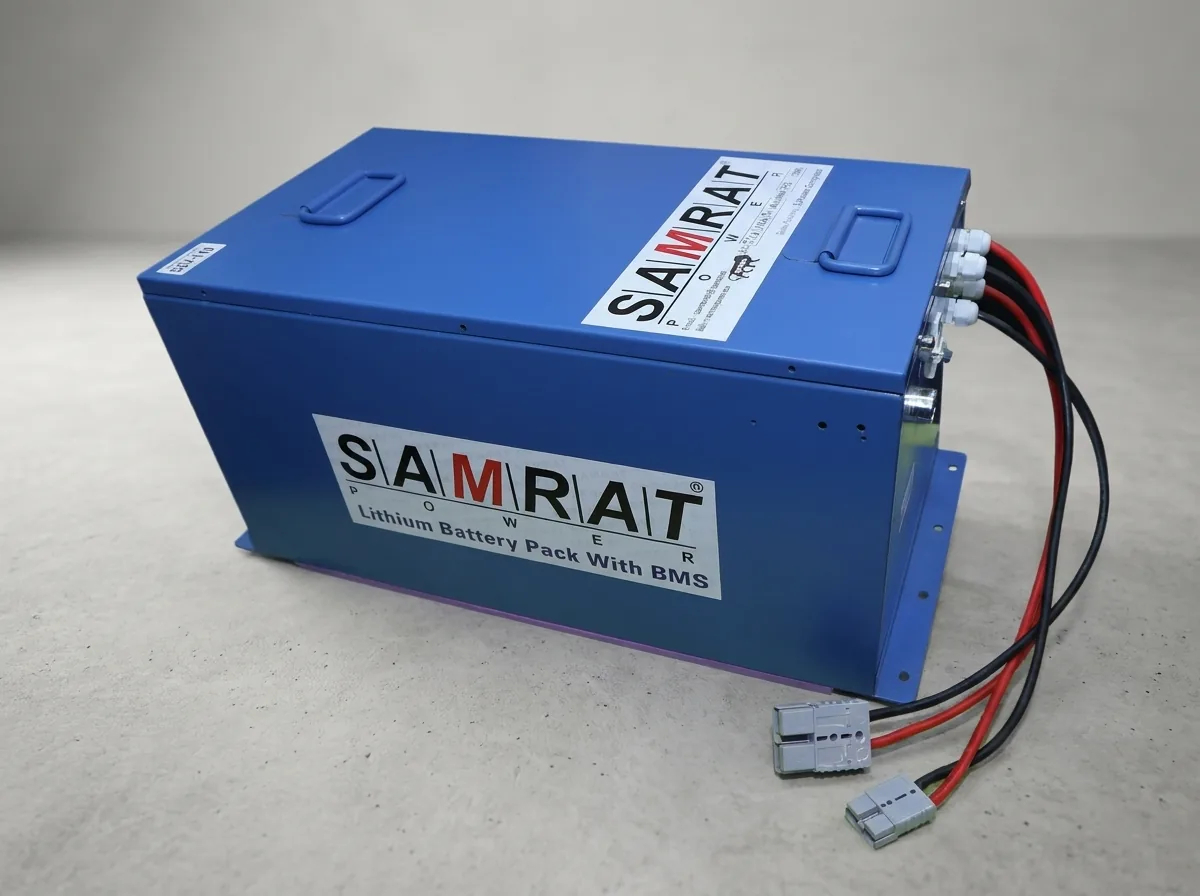
Customized Lithium Battery Pack
Every pack we build carries a BMS specified for its actual duty — continuous rating, balancing current, temperature sensing and low-temperature charge cut-off, stated in writing.
Price on request · 36-month warranty
In short
The BMS is the part of a lithium pack that decides whether good cells stay good. Protection keeps them out of the conditions that damage them; balancing keeps them equal, which is what stops usable capacity draining away year on year; measurement is how you find out either is working.
Ask for continuous ratings rather than peak, insist on per-cell monitoring, check the balancing current, and confirm there is a low-temperature charge cut-off. If a supplier can answer those four questions without hesitating, you are probably talking to someone who built the pack. If they cannot, you are talking to someone who bought it.
Frequently asked questions
What does a BMS do in a lithium battery?
Four things: it protects cells from over-voltage, under-voltage, over-current, short circuit and temperature extremes; it balances cells so they stay equal to one another; it measures state of charge, current and temperature; and it reports that data. Lithium has no natural tolerance for overcharge the way lead-acid does, so without a BMS a series pack is a set of individual risks wired together.
Why is cell balancing important?
Because a series string can only be charged until its strongest cell is full and discharged until its weakest is empty — so the pack behaves like its worst cell. Small manufacturing differences mean one cell always leads. Left uncorrected the weak cell is worked hardest at both ends of every cycle, degrades faster, and the gap widens. That runaway is how packs lose a third of their capacity in two years with no cell actually failing.
What BMS continuous current rating do I need?
Around 60A continuous for a 48V e-rickshaw, 50–60A for 60V, 60–80A for a 72V e-loader, and 30–50A for an e-scooter. The critical word is continuous: a board marketed as “100A” is typically 100A peak for a few seconds at 25°C, with a continuous rating nearer 40A that falls further in a hot sealed enclosure. Always ask for the continuous figure and the ambient temperature it was measured at.
Does a BMS balance the battery all the time?
No. Passive balancing — the common type — only works during the constant-voltage phase at the top of a charge. A pack that is habitually charged to 80% and unplugged never balances at all. If you mostly do short top-ups, let the pack complete a genuine full charge at least once a week so the BMS has the opportunity to do its job.
What is the difference between passive and active balancing?
Passive balancing bleeds excess charge off the strongest cell as heat through a resistor, typically at 30–150mA, and only near full charge. Active balancing transfers that energy to the weaker cell instead, works across a wider state-of-charge range and can move 1–5A. Active costs several times more. Good passive balancing is sufficient for most traction packs built from well-matched cells; active earns its cost on large packs, wider cell spreads, or storage that rarely reaches full charge.
Can a BMS stop my battery being damaged in winter?
A good one will. Charging a lithium cell below 0°C plates metallic lithium onto the anode — permanent, cumulative damage that eventually causes internal shorts. A BMS with a low-temperature charge cut-off blocks charging until the pack warms. This is one of the most commonly omitted protections on cheap boards, and it matters in north India where a vehicle parked outside overnight in January can easily be below freezing at dawn.