
Samrat Power System Pvt Ltd has been making power electronics in New Delhi since 1994. We started as D. Krishna Enterprises building inverters and home UPS systems, moved into EV battery chargers as the e-rickshaw trade grew across the city, and now build lithium battery packs alongside both.
Three decades in one trade in one city means we have watched this market change from the inside — from tubular lead-acid and transformer chargers, through the arrival of cheap imported lithium modules, to a regulatory framework that finally asks who built the pack and how. This page is about what we actually do, so you can judge whether we are the right people to build yours.
Where we are
Shop No. D-6 & D-7, Central Market, Tagore Garden Extension, New Delhi – 110027.
Tagore Garden is in West Delhi, on the Blue Line, and Central Market sits within a few minutes of the Tagore Garden and Subhash Nagar metro stations. If you are coming by road it is straightforward from Najafgarh Road and the Ring Road, and there is parking at the market.
| Address | Shop No. D-6 & D-7, Central Market, Tagore Garden Extn., New Delhi – 110027 |
| Phone | +91 98103 16115 · +91 92125 97222 |
| samratpower@gmail.com | |
| Open | Monday to Saturday, 9:00 am – 6:00 pm |
| Closed | Sunday and public holidays |
| Nearest metro | Tagore Garden / Subhash Nagar, Blue Line |
You are welcome to come with your vehicle. For a battery pack enquiry it is genuinely the fastest route — we can measure the tray, look at the connector and check the controller in twenty minutes, which otherwise takes several rounds of photographs. Call before you set out and we will make sure the right person is there.
What we make
| Product | What it is for | Price |
|---|---|---|
| Customized Lithium Battery Pack | Any voltage and capacity — e-rickshaws, e-carts, loaders, solar storage, industrial machines | On request |
| E-Scooty Battery (LFP) | Two-wheelers, six configurations from 51.2V to 73.6V | From ₹23,600 |
| 58V · 25A Lithium Charger | 16S LFP packs | ₹5,250 |
| 69V · 22A Lithium Charger | 19S LFP packs | ₹5,460 |
| 48V · 18A EV Charger | 48V e-rickshaw packs | ₹4,200 |
| 1500 Volt EV Charger | Heavy-duty e-rickshaw and e-cart packs | ₹6,300 |
| Samrat Lithium Inverter | Home and shop backup, pure sine wave | ₹31,860 |
| Solar Inverter · DSP Sine Wave | Hybrid solar PCU for homes and shops | ₹37,760 |
The custom pack is the bulk of what we do. Standard products serve the common cases; most of our work is packs built to a specification that does not exist off the shelf.
How a custom pack gets built
From first call to delivered pack, the process runs like this.
We ask what it has to do, not what you want to buy
Vehicle or application, daily duty, the worst load or gradient it will face, ambient conditions, and the space available. A pack specified from a duty cycle is a different object from one specified from a voltage and an amp-hour figure, and it is the difference between a pack that lasts and one that is merely delivered.
We propose a configuration
Cell count, capacity, chemistry, BMS specification, enclosure and connector — with the reasoning. If we think you have asked for more pack than you need, we will say so; if we think your budget will not survive the duty, we will say that too.
You approve a written specification
Cell make and model, BMS continuous ratings and protections, physical dimensions, weight, warranty. In writing before anything is built, so there is nothing to argue about later.
Cells are matched before assembly
Cells are tested and grouped so that the pack starts life balanced. Cell matching is invisible in the finished product and is one of the first things skipped in a cheap build — a pack assembled from unmatched cells begins drifting on day one.
Assembly and BMS integration
Series and parallel connections made and checked, BMS fitted and configured for the chemistry and duty, temperature sensors placed in the cell stack rather than on the board, wiring strain-relieved.
Test before it leaves
Capacity verified against the specification, protections confirmed to operate, balancing checked, insulation tested. Our quality process covers incoming material as well as finished goods.
Delivery and after
Free delivery across India by surface transport — lithium batteries are classified as dangerous goods and cannot travel by air, which is a regulatory constraint that applies to every seller. Then 36 months of warranty against manufacturing defects.
Steps four and six are the ones that separate manufacturers from assemblers, and they are invisible on a price list. It is worth asking anyone quoting you whether they do them.
Who we build for
Our work splits roughly four ways.
E-rickshaw and e-cart owners across Delhi NCR — single-vehicle owners replacing a worn lead-acid set, usually after being quoted for a fourth replacement in five years. This is where the cost arithmetic does most of the persuading.
Fleet operators running ten to a hundred vehicles, where the decisions are about standardisation, depot charging and uptime rather than about a single battery. Different questions, and usually two pack variants rather than one compromise.
Industrial and commercial customers needing packs for machines, material handling equipment, backup systems and stationary storage — applications that sit outside vehicle type approval and where specification quality matters most because nothing external is enforcing it.
Homes and shops buying inverters and solar storage, where the conversation is about load sizing rather than about batteries at all. Our solar sizing guide is essentially that conversation written down.
Three decades of watching this market change
We did not set out to be a battery company. In 1994 the business was inverters and home UPS, and the customer was a Delhi household tired of load shedding. Those were transformer-based units driving tubular lead-acid batteries, and the technology barely moved for a decade.
The first real change was the arrival of the e-rickshaw in the early 2010s. Delhi took to them faster than almost anywhere, and it created a demand nobody was serving properly: chargers that could survive being used twice a day, every day, by drivers with no interest in electronics. Most of what was available then was cheap transformer chargers that ran hot and failed within a year. Building better ones is how we moved from domestic power into EV.
The second change was lithium, and it arrived messily. Around 2018–2020 imported cells and modules became cheap enough that anyone with a soldering iron could assemble packs, and a great many people did. Packs were sold on amp-hours alone, cell provenance was not discussed, and the BMS was whatever board was cheapest that week. Plenty of those packs were fine. Plenty failed in eighteen months and taught an entire market to distrust lithium.
The third change is the one still under way: after the 2022 two-wheeler fires, regulation caught up. The pack rather than the cell became the unit of assessment, thermal propagation had to be designed for, and BMS specifications stopped being optional. That has been good for anyone who was already building packs properly and difficult for anyone who was not — which is roughly the point of it.
The through-line across all three is that this trade rewards knowing what is inside the box. It is why our guides spend so much time on questions like BMS continuous ratings and cell provenance: they are the questions that separated the packs that lasted from the packs that did not, in every one of those three eras.
Service and repair
A lithium pack is a repairable assembly, and treating it as disposable is a habit imported from the lead-acid trade.
The most common serviceable faults we see are a single cell that has drifted badly, a BMS that has failed while the cells remain healthy, and connection or connector damage. All three are repairs. On a nineteen-cell pack, replacing one cell and rebalancing costs a fraction of a new pack and returns it to near-original capacity, provided the rest of the cells have aged together and the problem is caught before the weak cell has dragged the others down.
That last condition is why we push people to bring packs in early. A pack showing gradual range loss over a few months is usually recoverable. The same pack twelve months later, having been cycled hard with one cell doing far more work than the rest, often is not.
We service packs we built and, where it is practical, packs we did not. Bring it in, or call first if the vehicle is not drivable.
Why buy from a manufacturer rather than a trader
A great deal of what is sold as Indian-made lithium is imported modules in a local box. That is not automatically bad — some imported modules are excellent — but it changes what your supplier can do for you.
| Trader / assembler | Manufacturer | |
|---|---|---|
| Can name the cells in your pack | Sometimes | Always |
| Can state the BMS continuous rating | Often not | Yes, in writing |
| Can build a non-standard size | Only from what is stocked | Yes |
| Can diagnose a fault at cell level | Usually replaces the whole unit | Yes |
| Can repair rather than replace | Rarely | Often |
| Warranty rests with | An importer, sometimes overseas | The company that built it |
The row that matters most in practice is the second-to-last. A pack with one weak cell in nineteen is a repair for whoever assembled it and a write-off for whoever did not. Over a 36-month warranty that difference decides whether a fault is an afternoon or an argument.
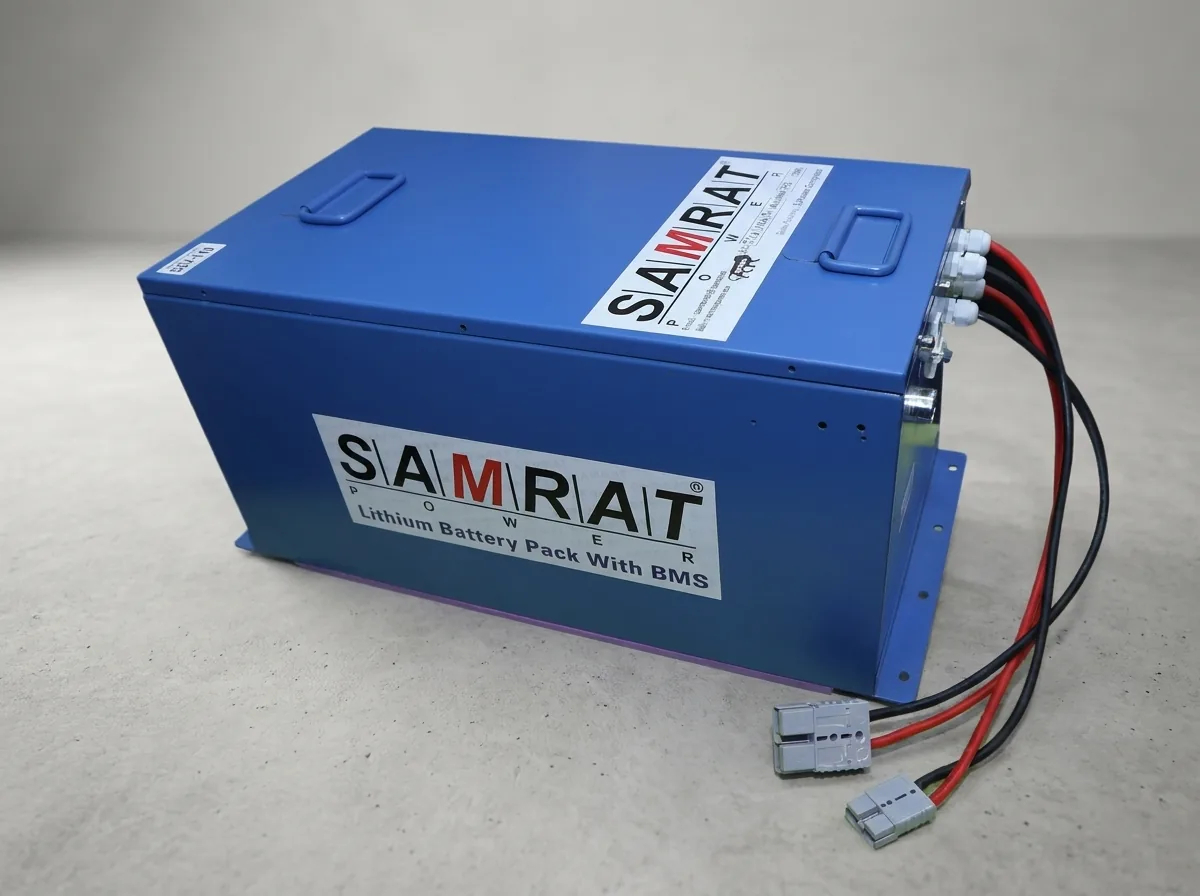
Customized Lithium Battery Pack
Tell us the duty and the space, and we will build the pack around it. Named cells, specified BMS, tested before it ships.
Price on request · 36-month warranty
Beyond Delhi
We are a Delhi manufacturer, and being local matters if you want to bring a vehicle in or have a pack looked at. But we deliver across India, free, on every order.
Two practical points for customers outside NCR. First, lithium batteries travel by surface transport only — they are classified as dangerous goods and cannot be sent by air. This applies to every seller in the country, and it means delivery to distant or north-eastern destinations takes longer than you may be used to for other goods. Second, specification accuracy matters more when we cannot see the vehicle. Photographs of the battery tray with a tape measure in frame, the connector, and the controller label will get you a correct pack the first time.
Our shipping policy sets out dispatch times and coverage in full.
Where to start
If you know what you want, the shop has our standard products with prices, and you can order online.
If you are replacing a pack and are not sure what you need, the fastest route is a phone call — +91 98103 16115, Monday to Saturday. Have the vehicle’s make, the number of batteries currently fitted, and a rough daily distance to hand.
If you are specifying something unusual — an industrial machine, a stationary bank, a vehicle we will not have seen — write to us with the duty cycle and the constraints. Those enquiries take a conversation rather than a quote, and we would rather have it properly.
And if you are still deciding whether lithium is right for you at all, start with the guides. Several of them explain when the answer is no.
One last thing worth saying plainly. This is a market where a great deal is sold on claims that cannot be checked — cycle counts with no capacity threshold attached, amp-hour ratings nobody has measured, certificates that describe a cell rather than a pack. We have written the guides on this site the way we have because the questions that expose all of that are simple ones, and any manufacturer should be able to answer them on the spot. Ask us the same questions you would ask anyone else. If we cannot answer them, buy elsewhere.
Frequently asked questions
Where is Samrat Power located in Delhi?
Shop No. D-6 & D-7, Central Market, Tagore Garden Extension, New Delhi – 110027, in West Delhi. The nearest metro stations are Tagore Garden and Subhash Nagar on the Blue Line, both a few minutes away, and there is parking at the market. We are open Monday to Saturday, 9:00 am to 6:00 pm, and closed on Sundays and public holidays.
Can I visit with my vehicle to get a battery pack made?
Yes, and for a custom pack it is the fastest route. We can measure the battery tray, check the connector and look at the controller in about twenty minutes, which otherwise takes several rounds of photographs and follow-up questions. Call +91 98103 16115 before you set out so the right person is there.
How long has Samrat Power been manufacturing batteries?
The company has been building power electronics in New Delhi since 1994, originally as D. Krishna Enterprises making inverters and home UPS systems. We moved into EV battery chargers as Delhi’s e-rickshaw trade grew, and now build lithium battery packs alongside both.
Do you deliver outside Delhi?
Yes, across India, and delivery is free on all orders. Two practical points: lithium batteries are classified as dangerous goods and travel by surface transport only — they cannot go by air, which applies to every seller and makes delivery to distant and north-eastern destinations slower. And when we cannot see the vehicle, send photographs of the battery tray with a tape measure in frame, the connector, and the controller label.
What is the difference between buying from a manufacturer and a trader?
A manufacturer can name the cells in your pack, state the BMS continuous rating in writing, build a non-standard size, diagnose a fault at cell level and often repair rather than replace it. The repair point matters most in practice: a pack with one weak cell in nineteen is an afternoon’s work for whoever assembled it and a write-off for whoever did not. It also determines whether your warranty rests with the company that built the pack or with an importer.
What warranty do you offer?
36 months on lithium battery packs, 24 months on inverters and on the 1500 Volt EV charger, and 12 months on the other EV chargers — all against manufacturing defects from the date of delivery. The full terms, including what is not covered, are set out in our refund and warranty policy.