
An e-rickshaw carries four adults — call it 280 kg — on a predictable route, at a steady 20–25 km/h, and spends much of its day coasting between signals. An e-loader carries 500 to 800 kg of cement, vegetables or scrap, often up a service road, often overloaded, and spends its day either accelerating hard or standing still.
These are not variations of the same duty. They are different duties, and the difference shows up as sustained current rather than as energy. A pack sized on range alone will deliver its advertised kilometres and then fail early for reasons the owner will never connect to the specification.
This guide is about specifying a 23S LFP pack for cargo work: what the duty actually demands, how to size for it, and what to check that nobody checks.
Why cargo work pushes you to 72V
The argument is the same one that takes passenger rickshaws from 48 V to 60 V, only more so. Power is voltage times current, and everything that fails in a traction system fails because of current.
A loaded e-loader on a gradient can demand 2 kW from its motor for tens of seconds at a time — not the one-to-three second pulse a passenger rickshaw sees pulling away from a signal, but a sustained draw while it grinds up a ramp with three-quarters of a tonne behind it.
| System | Nominal | Current for 2 kW | Relative I²R heating |
|---|---|---|---|
| 16S LFP | 51.2 V | 39.1 A | 100% |
| 19S LFP | 60.8 V | 32.9 A | 71% |
| 23S LFP | 73.6 V | 27.2 A | 48% |
Moving from 48 V to 72 V halves the resistive heating for the same delivered power. In a passenger rickshaw that is a nice-to-have. In a loader that spends fifteen seconds at a time at full demand in a 45 °C summer, it is the difference between a pack that lasts its rated life and one that does not.
Twenty-three LFP cells in series: 73.6 V nominal, 84.0 V fully charged, 57.5 V fully discharged. Sold as “72V”. The charger must terminate at 84 V — see the charger matching guide.
The duty cycle that actually matters
Ask any pack supplier what current their BMS handles and you will get a peak figure. Peak figures are close to meaningless for cargo work. What matters is the shape of the demand over time.
| Passenger e-rickshaw | Loaded e-loader | |
|---|---|---|
| Typical payload | 250–300 kg | 500–800 kg, frequently more |
| Cruise power | 800–1,200 W | 1,200–1,800 W |
| Peak demand duration | 1–3 seconds | 10–30 seconds on gradients |
| Energy per km | 40–55 Wh | 55–80 Wh |
| Starts per hour | High, but lightly loaded | Fewer, but each one heavily loaded |
| What limits the pack | Cycle count | Thermal accumulation |
That final row is the point of this entire page. A passenger pack wears out by being cycled. A cargo pack wears out by being heated — and heat accumulates. A pack that handles a thirty-second climb comfortably on the first run of the day may be 15 °C hotter by the fifth, because there was never enough standing time to shed the heat from the previous one. Sustained current with inadequate recovery time is the specific thing that kills loader packs.
Sizing the pack
Energy consumption for a loaded e-loader runs 55 to 80 Wh per kilometre depending on payload, gradient and how much of the route is stop-start. We plan on 65 Wh/km for a typical urban goods route, and 75 if the operator has told us the vehicle is regularly loaded past its rating — which, in this trade, it usually is.
| Capacity | Nameplate | Usable | Range, loaded | Continuous draw at 2 kW |
|---|---|---|---|---|
| 73.6V 60Ah | 4.42 kWh | 3.97 kWh | ~61 km | 0.45C — working hard |
| 73.6V 80Ah | 5.89 kWh | 5.30 kWh | ~82 km | 0.34C — acceptable |
| 73.6V 100Ah | 7.36 kWh | 6.62 kWh | ~102 km | 0.27C — comfortable |
| 73.6V 120Ah | 8.83 kWh | 7.95 kWh | ~122 km | 0.23C — easy |
The right-hand column is the one to read first, and it is why cargo packs should be sized larger than the range calculation alone suggests.
A 60 Ah pack delivering 27 A continuously is running at 0.45C. LFP will do that, but it will run warm doing it, and warm cells in a hot climate age faster. The same 27 A from a 120 Ah pack is 0.23C, which the cells barely notice. You are not buying the larger pack for the extra sixty kilometres; you are buying it so the cells spend their life loafing instead of straining.
Size for range, then check the C-rate at your realistic sustained power draw. If it comes out above 0.35C, go up one capacity step. The extra cost is far less than an early replacement.
Thermal margin, which nobody quotes
LFP is the right chemistry for this application precisely because it tolerates heat better than NMC — the reasoning is set out in our chemistry comparison. But tolerance is not immunity.
Cell life falls roughly by half for every 10 °C rise above about 30 °C. A pack running at 50 °C internal rather than 35 °C is not losing a few percent of its life; it is losing a large fraction of it. Three things drive internal temperature, and only one is under your control after purchase.
- Current, squared. Handled by choosing the right voltage and a generous capacity, as above.
- Ambient temperature. Not negotiable in an Indian summer.
- Ability to shed heat. Entirely a function of how the pack is built and where it is mounted — and routinely ignored.
On the third point, specify a metal enclosure rather than plastic, ask for air space around the cell stack rather than a tightly potted block, and mount the pack where it gets airflow rather than boxed under a steel floor above the exhaust of nothing at all. A pack in still air inside a sealed steel box will run 10–15 °C hotter than the same pack with ventilation, for free.
The parts of the system that are not the battery
Three-quarters of the loader problems we are asked to diagnose turn out not to be the pack.
Cable cross-section
A cable sized for a passenger rickshaw’s 20 A cruise will get hot carrying 30 A continuously up a ramp. Hot cable means voltage drop, voltage drop means the motor gets less than it should, and the driver responds by holding the throttle open longer — which draws more current. Undersized cable is self-reinforcing. For sustained 30 A on a 72 V system, 16 mm² is a sensible minimum for the main runs, and more if the runs are long.
Connectors
The single most common failure point in the whole vehicle. A connector rated for 50 A intermittent will degrade under 30 A continuous; each cycle of heating and cooling loosens it slightly, resistance rises, and it runs hotter still. Anderson-type connectors rated well above your continuous current, properly crimped, are worth the money. A blackened connector housing is a warning, not a cosmetic issue.
Controller rating
Controllers are also rated in peak and continuous, and the gap is often larger than for a BMS. A controller specified at “150 A” may be 150 A for ten seconds and 60 A indefinitely. On a loader, the continuous number is the one you live with.
Brakes and regeneration
A loaded cargo three-wheeler descending with 700 kg behind it puts real energy back into the pack if regenerative braking is enabled. That charging current arrives regardless of pack temperature or state of charge, and a BMS without proper charge-side protection can be pushed past cell limits by it. If the vehicle has regen, confirm the BMS is specified for it.
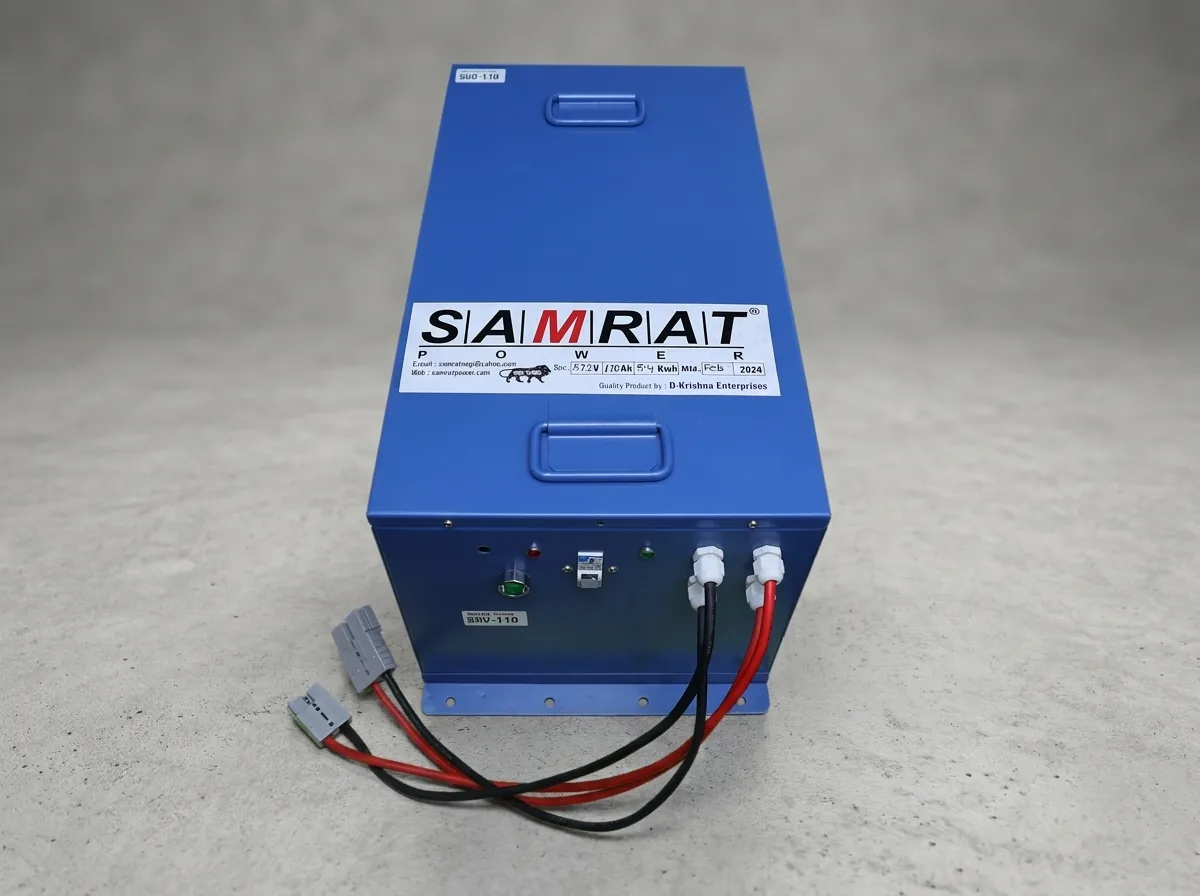
Customized Lithium Battery Pack
23S LFP packs built for cargo duty — generous BMS continuous rating, ventilated metal enclosure, sized to your tray. Made and tested in New Delhi.
Price on request
Reading a pack that is starting to go
Loader packs rarely fail suddenly. They give three or four months of warning, and operators routinely miss it because the early symptoms look like ordinary variation.
| What the driver notices | Likely cause | Whether it is still fixable |
|---|---|---|
| Range fine when cool, poor by afternoon | Thermal derating — the pack is running too hot for its duty | Yes, if ventilation or capacity is addressed |
| Cuts out on the steep section, recovers after a wait | BMS over-current or over-temperature trip | Yes — usually an undersized BMS, not dead cells |
| Range dropped 20% over a few weeks | Cell imbalance | Often, if caught early — a full balancing charge may recover it |
| One charge behaves differently from the next | A cell drifting badly | Sometimes — needs diagnosis, gets worse quickly |
| Connector or cable end discoloured | Resistive heating at a joint | Yes, and urgently — this is a fire precursor |
| Pack warm to the touch hours after use | Internal resistance rising | Rarely — usually late-stage |
The distinction worth internalising is between problems of specification and problems of condition. The first two rows are specification problems — the pack was never right for the duty, and it will keep doing this until something changes. The middle rows are condition problems that are often recoverable if caught. The last is usually terminal.
Cell imbalance in particular is worth acting on early. Because passive balancing only operates at the very top of a charge, a loader that is habitually charged to 80% between shifts and never taken to full will drift steadily. Running one deliberate full charge to completion each week — not interrupting it when the current tapers — costs an hour and prevents the single most common cause of premature capacity loss in fleet packs.
The economics are different too
A cargo operator is not comparing cost per kilometre. They are comparing cost per trip, and the binding constraint is usually how many loads can be moved in a day rather than how far the vehicle can travel.
That changes what you should optimise. If your route is a 12 km round trip repeated eight times a day, you need 96 km of range — but more importantly you need the vehicle available for all eight trips. A pack that covers 100 km but takes seven hours to charge caps you at eight trips a day. A pack that covers 120 km and can take a fast partial charge during loading and unloading may allow ten or eleven.
Loading time is dead time that the vehicle spends stationary anyway. A cargo three-wheeler typically stands for twenty to forty minutes per load being filled and emptied. At 0.3C that is 10–20% of pack capacity recovered per stop, for free, using time that was already lost. Over a working day this can add several trips without extending anyone’s hours — but only if there is a charge point where the loading happens, and only if the pack and BMS are specified to accept a meaningful charge current.
This is worth modelling before you buy, because it can change which pack you want. We are happy to work it through with you against your actual route and load pattern.
Specifying a loader pack
Real payload, not rated payload
Tell us what the vehicle actually carries, including the days it is overloaded. We would rather specify for the truth than for the certificate.
The worst gradient on the route
A single steep service road entrance can define the pack’s continuous current requirement even if it is fifty metres long. Describe it.
Motor and controller ratings
Continuous figures for both, from the labels. Photographs are fine.
Trips per day and standing time per trip
This determines whether opportunity charging is worth designing for, and how large the charger should be.
Tray dimensions and mounting
In millimetres, and tell us whether the pack sits in open air or inside a closed compartment. The answer changes how we build the enclosure.
Whether regenerative braking is fitted
If it is, the BMS specification changes on the charge side.
If you run a fleet of loaders rather than one, the answers to these questions tend to differ more between routes than between vehicles. It is usually worth specifying two pack variants rather than one compromise, and our fleet guide covers how to think about that.
Frequently asked questions
What is a 72V lithium battery for an e-loader?
Twenty-three LFP cells in series — 23S — giving 73.6V nominal, 84.0V fully charged and 57.5V fully discharged. It is sold as “72V” because it replaces a six-block 72V lead-acid arrangement. The charger must terminate at 84V.
Why does a cargo three-wheeler need 72V rather than 60V?
Because cargo duty is defined by sustained current, not peak current. A loaded e-loader can demand 2kW for tens of seconds climbing a ramp, where a passenger rickshaw sees one-to-three second pulses. At 73.6V that 2kW needs 27.2A against 39.1A at 51.2V, which more than halves resistive heating. Heat accumulates across a working day, and accumulated heat is what kills loader packs.
What capacity do I need for an e-loader?
Size for range at 55–80Wh per kilometre depending on payload and gradient, then check the C-rate at your sustained power draw. If the continuous draw works out above 0.35C, go up one capacity step. For a typical urban goods route, a 73.6V 100Ah pack gives around 100km loaded and runs at a comfortable 0.27C under a 2kW draw.
Why do e-loader battery packs fail early?
Almost always heat rather than cycles. Cell life roughly halves for every 10°C above about 30°C, and a pack that never gets standing time to shed heat between heavy climbs accumulates temperature across the day. The three drivers are current squared, ambient temperature, and the pack’s ability to shed heat — the last being entirely a function of enclosure design and mounting, and the one most often ignored.
What cable size does a 72V e-loader need?
For sustained 30A on the main runs, 16mm² is a sensible minimum, and more for long runs. Undersized cable is self-reinforcing: it heats, which causes voltage drop, which makes the motor underperform, which makes the driver hold the throttle open longer and draw more current. Connectors matter as much as cable — a connector rated 50A intermittent will degrade under 30A continuous.
Can I charge an e-loader pack while it is being loaded?
Yes, and it is often the most valuable thing you can do. A cargo three-wheeler typically stands 20–40 minutes per load. At 0.3C that recovers 10–20% of capacity per stop using time already lost, which can add several trips a day. It requires a charge point where loading happens and a pack and BMS specified to accept that charge current.