
A low-speed electric scooter sold in India three or four years ago almost certainly left the showroom with a sealed lead-acid pack — typically four or five 12 volt blocks under the footboard, weighing 40 kg or so, good for perhaps 60 km when new and 35 km by the second summer.
Those packs are now reaching the end of their lives in large numbers, and their owners face a straightforward choice: replace like with like for a modest sum and repeat the exercise in eighteen months, or move to lithium. This guide is about what actually changes when you do the second thing.
What changes, in order of how much you notice
| Lead-acid (5 × 12V 32Ah) | LFP 61V 32Ah | |
|---|---|---|
| Nameplate energy | 1.92 kWh | 1.95 kWh |
| Usable energy | ~1.06 kWh | ~1.76 kWh |
| Weight | ~42 kg | ~13 kg |
| Realistic range | 40–50 km | 90–110 km |
| Charge time | 7–9 hours | ~2 hours |
| Life | 250–400 cycles | 2,000–3,000 cycles |
| Range in month 18 | Roughly half of new | Barely changed |
Three things stand out, and only one of them is the one people expect.
The weight. Taking 29 kg off a scooter that weighs perhaps 90 kg is a third of the vehicle. It changes how it steers, how it stops, and how easily it can be pushed when the battery does run out. Riders consistently report this as the most noticeable change, ahead of range.
The charge time. Two hours instead of eight converts the battery from something you plan your day around into something you top up while you have lunch. For anyone using the scooter for deliveries, this is the difference between one shift and two.
The flatness of the range over time. A lead-acid pack’s range decays continuously and noticeably; by month eighteen it does half what it did when new. An LFP pack holds close to its rated capacity for years and then declines gently. The absence of that steady disappointment is worth more than the headline figure.
Notice that the two packs above have almost identical nameplate energy but the LFP delivers 66% more usable energy. Lead-acid should not be taken below about 55% depth of discharge; LFP is comfortable at 90%. A like-for-like nameplate swap is therefore a substantial upgrade in real range, not a lateral move.
Choosing the configuration
Two numbers define your pack: voltage, which is fixed by your scooter, and capacity, which is your choice.
Voltage first. It is set by the motor and controller, and it is not negotiable. Count the original lead-acid blocks:
| Original | System | LFP equivalent | Nominal | Charger terminates at |
|---|---|---|---|---|
| 4 × 12V | 48 V | 16S | 51.2 V | 58.4 V |
| 5 × 12V | 60 V | 19S | 60.8–61 V | 69.4 V |
| 6 × 12V | 72 V | 23S | 73.6 V | 84.0 V |
Our e-scooty battery comes in six configurations built around exactly this: 51.2 V, 61 V and 73.6 V, each in 32 Ah or 45 Ah. Match the voltage to your scooter, then pick the capacity.
Capacity is the interesting decision. A two-wheeler uses roughly 18–22 Wh per kilometre — far less than a three-wheeler, because it is moving a fraction of the mass.
| Configuration | Nameplate | Usable | Realistic range | Price |
|---|---|---|---|---|
| 51.2V · 32Ah | 1.64 kWh | 1.47 kWh | ~74 km | ₹23,600 |
| 51.2V · 45Ah | 2.30 kWh | 2.07 kWh | ~104 km | ₹33,040 |
| 61V · 32Ah | 1.95 kWh | 1.76 kWh | ~88 km | ₹28,320 |
| 61V · 45Ah | 2.75 kWh | 2.47 kWh | ~124 km | ₹40,120 |
| 73.6V · 32Ah | 2.36 kWh | 2.12 kWh | ~106 km | ₹30,680 |
| 73.6V · 45Ah | 3.31 kWh | 2.98 kWh | ~149 km | ₹44,840 |
Those ranges assume a single rider of average weight, mostly flat urban roads and moderate speed. Two riders, a headwind or an aggressive throttle will take 20–30% off. As with any vehicle, size for the day you need it most.
Fitment: the part that goes wrong
Electrically the swap is simple. Mechanically it needs thought, because the battery compartment was designed around something four times heavier and a different shape.
Measure the compartment, not the old battery
Length, width and height of the usable space, in millimetres, including any intrusions — brackets, wiring looms, the edge of a moulding. A lithium pack is a solid block and cannot be persuaded around an obstruction the way five separate blocks could be.
Plan how it will be held
The old pack largely stayed put through sheer mass. A 13 kg pack in the same well will move, and a pack that moves will eventually chafe a cable. It needs a strap, a bracket or foam packing that positively locates it. This is the single most commonly skipped step.
Check where the weight ends up
Removing 29 kg from low in the chassis raises the centre of gravity and shifts the balance. Keep the pack as low and as central as the compartment allows.
Photograph the connector
Both ends, with something for scale. More upgrades are delayed by connector mismatches than by every electrical question combined.
Reset the controller cut-off if it is adjustable
A controller expecting lead-acid will have a low-voltage cut-off set for a lead-acid discharge curve. On LFP it will either never trigger or trigger far too late, leaving the BMS to do the cut-off. Where the controller allows it, set the cut-off just above the BMS floor.
Replace the charger
Not optional. A lead-acid charger holds a float voltage indefinitely, which ages lithium cells and, over months, measurably reduces capacity. See our charger matching guide.
It is the most common false economy in this upgrade. The termination voltages can look close enough that it appears to work, and the damage is invisible for months. Budget for the correct charger as part of the job.
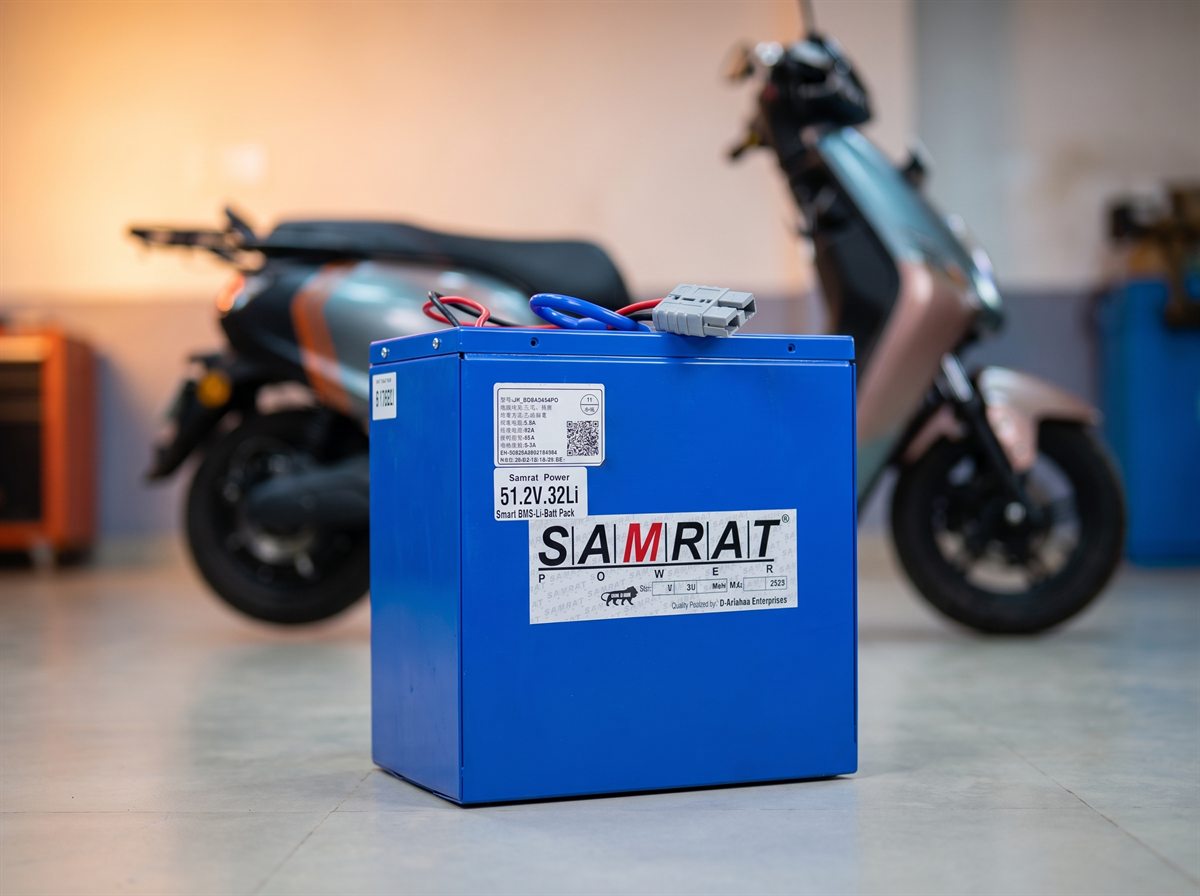
E-Scooty Battery (LFP)
Six configurations from 51.2V to 73.6V, in 32Ah or 45Ah. LFP chemistry, smart BMS, about two hours to charge, and our longest warranty.
From ₹23,600 incl. GST · 36-month warranty
Which scooters this suits — and which it does not
The upgrade makes most sense on low-speed and moderate-speed electric scooters of the kind sold widely in India from roughly 2018 onwards: a hub motor of 250–1,200 W, a simple controller, and a lead-acid pack under the footboard. On those it is a well-understood job.
There are three situations where it needs more care, and one where we would tell you not to bother.
Scooters with a proprietary battery interface
Some newer models communicate between the pack and the vehicle over CAN or a proprietary serial link — the dashboard reads state of charge from the BMS, and the controller will not enable without a handshake. A generic replacement pack will not satisfy that, and the scooter may refuse to run or display permanent faults. If your dashboard shows a real percentage rather than a bar graph derived from voltage, assume there is a data link and ask us before ordering.
Vehicles still under manufacturer warranty
Fitting a non-original battery will almost certainly void the vehicle warranty on anything electrical. If the scooter is under two years old, that may matter more than the upgrade does. Worth checking the terms rather than discovering it later.
Removable or swappable battery designs
Where the pack is designed to be lifted out and carried indoors to charge, the mechanical interface — latches, rails, handle, contacts — is part of the vehicle’s design and is much harder to replicate. These are usually best served by the original manufacturer.
Where we would say do not bother
A very old scooter with a tired motor, worn brakes and corroded wiring is not a good candidate. A new pack will outlive the vehicle around it, and you will have spent ₹28,000 on a machine worth less than that. Battery upgrades are worth doing on vehicles with several good years left in them.
Charging a scooter battery at home
This deserves its own note, because a scooter is charged somewhere quite different from a rickshaw. Rickshaw packs live outdoors. Scooter packs get carried into flats, charged in stairwells, plugged in beside a bed.
That is precisely the setting that made electric two-wheeler fires a national story in 2022, and it is the reason we build these packs in LFP rather than the lighter NMC. But chemistry is a margin, not a guarantee, and a few habits matter:
- Charge on a hard, non-flammable surface with space around the charger. Not on a bed, not on a carpet, not inside a cupboard.
- Do not block the stairwell. Beyond the fire risk, a charging pack in the only exit route is the specific arrangement that turns an incident into a tragedy.
- Use the charger that came with the pack. A borrowed charger of roughly the right voltage is the most common cause of avoidable damage.
- Do not charge a visibly damaged pack. Dents, swelling, a cracked case or a burnt smell mean stop, unplug and call us.
- Let it cool first if the scooter has just come off a long run in summer.
Why we build these in LFP
NMC is lighter for the same energy, and on a weight-sensitive vehicle that is a real argument. We build in LFP anyway, for three reasons.
The first is safety margin. A scooter is parked where people live — in stairwells, under buildings, in the corner of a room, on charge overnight. LFP’s thermal runaway threshold is around 270 °C against roughly 210 °C for NMC, and it releases less energy if it does fail. That margin matters more in a domestic setting than anywhere else.
The second is heat. A scooter pack sits under a black footboard in direct sun, in a country where 45 °C afternoons are ordinary. LFP tolerates sustained heat considerably better, and heat is the main driver of calendar ageing.
The third is life. Two to three times the cycle life turns a battery from a consumable into a component. It is why we can offer 36 months on these packs.
The full reasoning is in our LFP vs NMC comparison, including the cases where we would recommend NMC instead.
Living with it
A few things are normal and worth knowing in advance.
- The gauge is not linear. LFP holds a nearly flat voltage across most of its discharge, so a simple gauge reads full for a long time then drops quickly. Learn your range in kilometres and trust that instead.
- Winter range falls by 10–15%. Temporary, fully recovered when the weather warms. Nothing is wrong.
- Never charge below freezing. If the scooter has been parked outside on a January night in north India, bring it inside and let it warm before plugging in. Charging a sub-zero lithium cell causes permanent, cumulative damage.
- Let it charge fully once a week. Cell balancing only happens at the very top of a charge. A pack that only ever gets short top-ups never balances, and an unbalanced pack loses usable range steadily.
- Partial charging is otherwise fine. Unlike lead-acid, LFP has no memory effect and no requirement to be fully cycled. Top up whenever it is convenient.
- Store it part-charged. If the scooter will stand for a month or more, leave the pack at roughly half charge rather than full. Cells age fastest sitting at 100%.
More detail on all of this is in our guide to charging habits and battery lifespan.
Is it worth it?
Take a rider doing 40 km a day. A lead-acid pack at ₹13,000 lasts around 18 months in that duty; the LFP equivalent at ₹28,320 should manage five to six years. Over six years that is four lead-acid sets at ₹52,000 against one lithium pack at ₹28,320 — before counting the electricity difference or the fact that the lead-acid rider spends half of each replacement cycle with a battery doing 60% of its rated range.
The break-even sits somewhere around month 26 to 30, which is the same place the e-rickshaw arithmetic lands. Below about 15 km a day, or if you plan to sell the scooter within two years, lead-acid remains the rational choice. Above that, and particularly if the scooter earns money, the answer is lithium.
Frequently asked questions
Can I replace my scooty lead-acid battery with lithium?
Yes, provided the voltage matches. Count the original 12V blocks: four means a 48V system needing a 16S LFP pack, five means 60V needing 19S, six means 72V needing 23S. The mechanical side needs more thought than the electrical — the compartment was designed for a pack four times heavier, so the new one must be positively secured rather than left to sit. You also need a matching lithium charger.
How much range will I gain switching a scooty to lithium?
Roughly double. A five-block lead-acid pack of 1.92kWh nameplate delivers about 1.06kWh usable because lead-acid should not go below roughly 55% depth of discharge. An LFP pack of the same nameplate delivers about 1.76kWh usable at 90% depth. In practice a 40–50km lead-acid scooter becomes a 90–110km one, and it holds that range for years rather than decaying steadily.
How much weight does a lithium scooty battery save?
Around 29kg on a typical five-block system — 42kg of lead-acid against about 13kg of LFP. On a scooter weighing roughly 90kg that is a third of the vehicle, and riders usually report the handling change as more noticeable than the extra range. It does raise the centre of gravity, so mount the pack as low and central as the compartment allows.
Do I need a new charger when I upgrade to lithium?
Yes, and skipping it is the most common false economy in this upgrade. A lead-acid charger drops to a float voltage and holds the pack there indefinitely, which ages lithium cells and measurably reduces capacity over months. The termination voltages can look close enough that it appears to work, which is exactly why the damage goes unnoticed. A 16S LFP pack needs a charger terminating at 58.4V, 19S needs 69.4V and 23S needs 84V.
Which configuration should I choose for my scooter?
Voltage is fixed by your scooter — match the original block count. Capacity is your choice: a two-wheeler uses roughly 18–22Wh per kilometre, so a 61V 32Ah pack gives about 88km and a 61V 45Ah about 124km for a single rider on flat urban roads. Subtract 20–30% for two riders, hills or hard riding, and size for the day you need most rather than an average day.
Why is the scooty battery LFP rather than NMC?
Three reasons, and we accept the weight penalty deliberately. Safety margin — a scooter is parked and charged where people live, and LFP’s runaway threshold is around 270°C against roughly 210°C for NMC. Heat — the pack sits under a black footboard in Indian summers, and LFP tolerates sustained heat far better. Life — two to three times the cycle life, which is what lets us offer a 36-month warranty.