


Specifying a battery for an industrial machine is a different exercise from buying one for a vehicle. There is no standard configuration to copy, no market convention to fall back on, and usually no second chance — the pack has to fit a space that already exists, satisfy a duty cycle somebody else designed, and keep working in an environment nobody chose with batteries in mind.
We build these packs to order, and the enquiries that go well have something in common: they describe the duty rather than the battery. This guide sets out what to work out before you ask anyone for a quote.
Start with the duty cycle, not the capacity
The most common way an industrial pack goes wrong is that it was specified by energy alone. Somebody calculated that the machine consumes 2 kWh per shift, ordered a 2.5 kWh pack, and discovered six months later that it was dying early.
Energy tells you how long the machine runs. It tells you nothing about how hard the battery works while it does. Four applications can share an identical 2.5 kWh requirement and need four completely different packs.
| Application | Discharge pattern | What governs the design |
|---|---|---|
| AGV / warehouse robot | Steady moderate draw, frequent opportunity charging | Cycle life and charge acceptance — many partial cycles a day |
| Material handling / stacker | Long idle periods, heavy surges on lift | Peak current and voltage sag under load |
| Telecom site backup | Float for weeks, occasional deep discharge | Calendar life and self-discharge, not cycle life |
| Mobile medical equipment | Light, intermittent, safety-critical | Reliability, certification and predictable state of charge |
Before specifying anything, write down five numbers:
- Continuous current the machine draws in normal operation.
- Peak current, and for how long. A three-second lift surge and a thirty-second climb are different problems.
- Cycles per day. One deep cycle, or fifteen shallow ones?
- Ambient temperature range, including the worst case. A pack in a foundry aisle and a pack in a cold store are opposite problems.
- Expected service life in years, and what happens commercially when it ends.
Divide continuous current by pack capacity in amp-hours. Under 0.3C is comfortable. Between 0.3C and 0.5C is workable with attention to cooling. Above 0.5C continuous, you need cells specified for it and you should expect shorter life. If your number is high, the answer is usually a bigger pack rather than better cells.
Voltage: higher than you think
Industrial machines inherit their voltage from whatever they replaced, which is often a lead-acid system chosen decades ago. If the machine is being redesigned rather than retrofitted, it is worth revisiting.
Power is voltage times current, and every problem in a battery system scales with current, not voltage. Resistive heating rises with the square of current, so moving from 24 V to 48 V for the same power halves the current and cuts heating in the cables, connectors, contactors and cells to a quarter.
Against that, higher voltage means more cells in series, which means more to balance and more to monitor, and above certain thresholds it brings additional electrical safety requirements. For most industrial applications in the 1–5 kW range, 48 V is the sensible landing point.
Chemistry: LFP for nearly everything
For industrial use we specify LFP (lithium iron phosphate) in almost every case, and the reasoning is different from the vehicle argument.
Industrial machines are rarely weight-constrained. A stacker, an AGV or a telecom cabinet does not care that LFP stores less energy per kilogram than NMC — and in some cases the extra mass is actively useful for stability. What industrial buyers do care about is service life, predictability and not having a fire in a building full of stock.
| Requirement | Why LFP wins |
|---|---|
| Long service life | 2,000–6,000 cycles against 1,000–2,000 for NMC. Machine replacement cycles are long; battery replacement is disruptive. |
| Heat tolerance | Industrial environments run hot and rarely have battery cooling. LFP degrades more slowly at elevated temperature. |
| Safety margin | Thermal runaway onset around 270 °C against roughly 210 °C, with lower energy release. Matters in an occupied building. |
| Float tolerance | Backup applications hold a pack near full for long periods. LFP handles this better. |
| Cost per delivered kWh | Lower over life, because life is longer. |
The exception is genuine weight or space constraint — portable instruments, handheld equipment, anything a person carries. There, NMC’s density is decisive. Our chemistry comparison works through the trade-off in full.
The BMS is the specification
In industrial work more than anywhere else, the battery management system is where the requirement actually lives, because industrial packs are usually integrated into a larger control system rather than operated by a person.
Beyond the standard protections, three things matter disproportionately:
Communication
Does the machine need to know the battery’s state? A CAN or Modbus interface lets a controller read state of charge, current, temperature and fault flags, and act on them — slowing a machine as the pack depletes rather than stopping dead, or refusing to start a lift cycle it cannot finish. Retrofitting this later is expensive; specifying it at the start costs little.
Accurate state of charge
LFP’s discharge curve is almost flat, so voltage is a poor proxy for remaining energy. Any application where an operator or controller must know how much is left needs a BMS that counts coulombs. On a machine that must not stop mid-task, this is not optional.
Honest continuous ratings
A BMS advertised at 100 A is often 100 A peak and 40 A continuous, and lower still at 45 °C inside a sealed enclosure. Ask for the continuous figure and the temperature it was measured at. Our BMS guide lists the questions worth asking.
Environment: the requirement everyone forgets
Industrial environments are harsher on batteries than vehicles are, in ways that are easy to overlook at specification time.
- Dust. Cement, flour, textile lint and metal swarf all find their way into enclosures. Conductive dust in particular is a genuine hazard. Specify an ingress rating — IP65 as a floor, higher where washdown is involved.
- Vibration. Continuous vibration works connections loose over months. Bolted busbars need locking arrangements; cell fixings need to hold the stack rigidly.
- Washdown. Food and pharmaceutical sites hose equipment down. That is IP67 territory and a sealed connector standard.
- Ambient extremes. Cold stores are the case people miss: charging a lithium pack below 0 °C causes permanent damage, so a cold-store application needs either a heated pack or a charging regime that only runs when the pack is warm.
- Chemical exposure. Solvents and cleaning agents attack cable insulation and gaskets. Say so if it applies.
Charging strategy shapes the pack
How the pack is charged changes what it should be, and this decision is often made last when it should be made early.
| Strategy | How it works | What it demands of the pack |
|---|---|---|
| Overnight charge | One full charge in a long window | Simplest. Modest charger, low C-rate, gentlest on cells. |
| Opportunity charging | Short top-ups during natural idle time | Higher charge current, good charge acceptance, and a BMS that balances despite rarely reaching full. |
| Pack swapping | Spare packs rotated through a charging station | More packs, connector durability, and a system for tracking which pack is which. |
Opportunity charging is the one that catches people out. It can substantially reduce the pack size you need — a machine that tops up during every natural pause needs far less stored energy than one charged once a night. But because passive cell balancing only happens at the top of a full charge, a pack that never completes one will drift out of balance and lose usable capacity. The fix is straightforward: schedule one full charge to completion each week, and specify a BMS with adequate balancing current.
Retrofit or redesign?
Most industrial battery enquiries are retrofits — an existing machine whose lead-acid battery has become impractical — and retrofits carry constraints a new design does not.
The battery compartment is fixed, and it was sized for a lead-acid battery of a particular shape. A lithium pack of equivalent usable energy is roughly a third of the volume, which sounds like an advantage until you realise the compartment has mounting points, cable entries and a lid designed around the old dimensions. Filling the space with a bigger pack is often the right answer; leaving it half empty means the pack must be positively located and braced.
Weight is the second retrofit trap, and it runs the opposite way to intuition. On some machines the battery is ballast. Forklifts and stackers are the obvious case: the counterweight calculation assumes a battery of a particular mass, and removing 200 kg from the rear of a stacker changes its rated lifting capacity and its stability. Never replace a lead-acid battery on a lifting machine with a much lighter lithium pack without checking the manufacturer’s counterweight requirement — the usual answer is to add compensating ballast, which is straightforward if you know about it beforehand.
Third is the charging interface. The existing charger will not work, and on some machines it is integrated rather than standalone. Establish early whether you are replacing a plug-in charger or modifying the machine.
Where the machine is being designed rather than adapted, take the opportunity to raise the system voltage, place the pack where it can shed heat, and specify a communication interface from the start. All three are cheap at design time and expensive afterwards.
What a good enquiry contains
Send these and you will get an accurate quote first time rather than after three rounds of questions.
The machine and what it does
Make and model if it exists, or a description of the function. Context prevents a lot of wrong assumptions.
Electrical duty
System voltage, continuous current, peak current and its duration, and daily energy or run time.
Cycles and pattern
How many cycles a day, how deep, and whether charging is overnight, opportunistic or by swapping.
The space, in millimetres
Length, width, height, and any intrusions. Include how the pack is retained and which way it is removed for service.
Environment
Temperature range, dust, moisture, washdown, vibration, chemicals.
Interfaces
Connector type, and whether the machine needs to talk to the BMS — and if so, over what.
Compliance
Any standard the finished machine must meet. Cheaper to design for than to retrofit. See our guide to Indian battery safety standards.
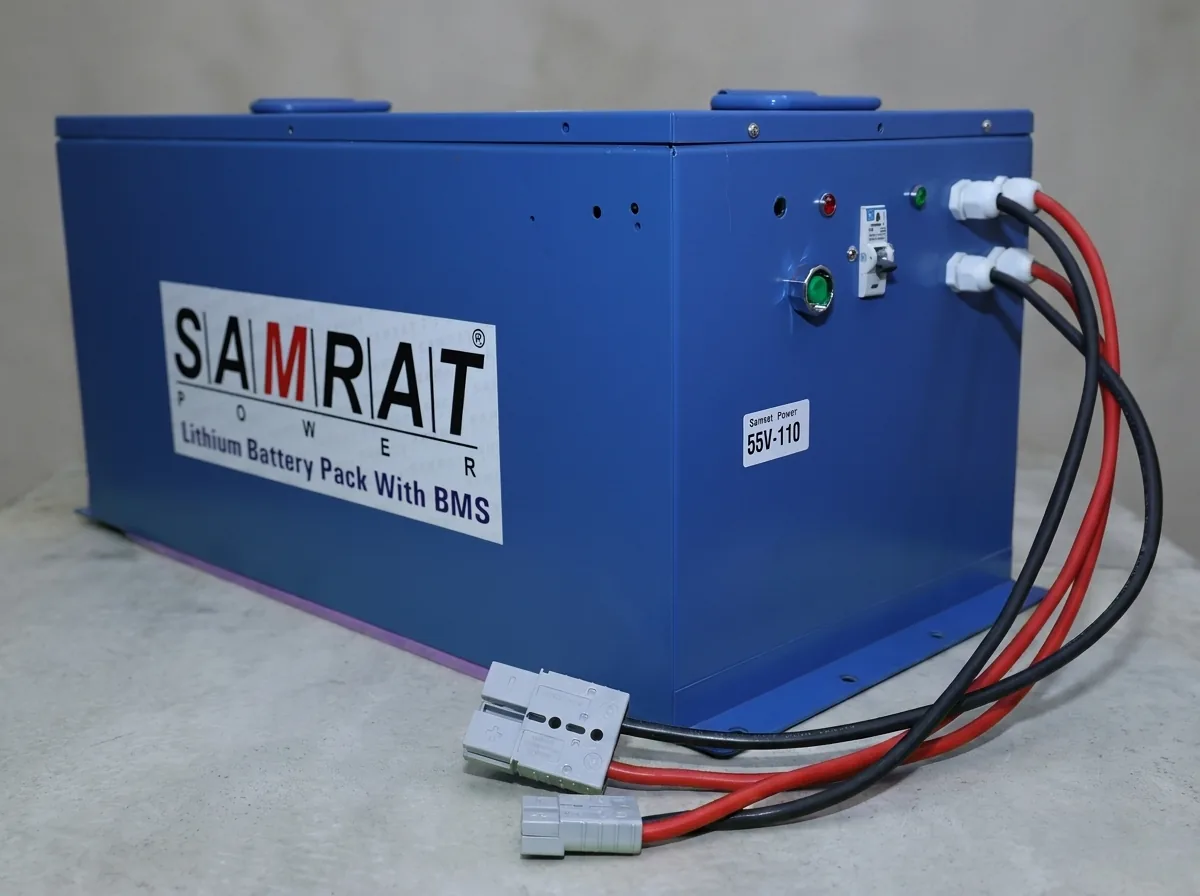
Customized Lithium Battery Pack
Built to your duty cycle, enclosure and interface — named cells, a BMS specified in writing, assembled and tested at our New Delhi facility since 1994.
Price on request · 36-month warranty
Total cost, not purchase price
Industrial buyers are usually better than consumers at thinking in lifetime cost, but battery quotes still get compared on the wrong basis.
The number that matters is cost per delivered kWh over the pack’s life — purchase price divided by (usable energy per cycle × realistic cycles). A pack that costs 20% more and lasts twice as long is comfortably cheaper. So is a pack that costs 20% more and does not require the machine to stop for a replacement mid-contract.
Add the costs that never appear on a quotation: downtime while a pack is changed, labour, the cost of holding spares, and the risk that a supplier who cannot identify the cells in your pack will not be able to repair it in year three. On a machine that earns money, unplanned downtime frequently exceeds the entire purchase price difference.
“If one cell fails in year two, what happens?” A manufacturer replaces the cell and rebalances the pack. A trader replaces the pack. Over a 36-month warranty, that difference is usually larger than the price difference that made you choose them.
Where to start
If your application is close to a standard configuration, our guides cover the common cases — sizing, chemistry, charger matching and compliance. If it is genuinely bespoke, which most industrial work is, the fastest route is a conversation.
Send us the duty cycle and the constraints rather than a battery specification, and we will tell you what we would build and why — including when a smaller and cheaper pack would do the job. Get in touch, or call +91 98103 16115, Monday to Saturday.