


A charging depot has a property that makes it an unusually good match for rooftop solar, and most operators never notice it: its vehicles are frequently standing still during daylight.
That coincidence — generation and demand happening at the same time — is the thing every solar installation is trying to achieve and most struggle with. A home generates at midday and consumes in the evening, so it needs either grid export or a battery to bridge the gap. A depot with vehicles parked between shifts can consume its generation as it happens.
This page covers how to size such a system, when storage is worth adding, and what the economics look like. It is the commercial counterpart to our domestic solar sizing guide, and the arithmetic differs enough to be worth treating separately.
Why depot charging suits solar
| Site | Peak generation | Peak demand | Directly self-consumed |
|---|---|---|---|
| Home | 11am–3pm | 7pm–11pm | Low without storage |
| Shop or office | 11am–3pm | 10am–8pm | Good |
| Charging depot, single shift | 11am–3pm | Overnight | Poor without storage |
| Charging depot, opportunity charging | 11am–3pm | Throughout the day | Very good |
| Cargo fleet with midday loading | 11am–3pm | Loading breaks | Excellent |
The bottom two rows are the interesting ones, and they point at an operational decision rather than an engineering one. A fleet that charges exclusively overnight gets little direct benefit from solar and needs storage to make it work. A fleet that tops up during natural standing time — loading, unloading, driver breaks — consumes solar as it is generated and needs far less storage, or none.
For cargo three-wheelers this is close to free. A loader stands 20 to 40 minutes per load being filled and emptied, which at a modest charge rate recovers 10–20% of pack capacity per stop. Doing that under a solar array during daylight is the cheapest energy the operation will ever get. Our fleet management guide covers the operational side of opportunity charging.
Shifting even a third of charging into daylight changes the economics of a solar installation more than any equipment choice you can make. Work out what is operationally possible first, then size the system around it.
Sizing the array
Start from energy consumed, not from roof area.
A single e-rickshaw takes roughly 5–6 kWh from the wall for a full charge. Twenty vehicles charging once daily is 100–120 kWh per day.
Solar output is calculated from peak sun hours — the equivalent hours of full-rated output per day — multiplied by a derating factor covering dust, heat, cable losses and imperfect orientation. In Indian conditions 0.75 is realistic; treat any proposal using 0.85 with suspicion.
| Daily charging demand | Share from solar | Array needed (Delhi, 4.75 PSH) | Roof area, approx. |
|---|---|---|---|
| 50 kWh (10 vehicles) | 50% | ~7 kW | ~450 sq ft |
| 50 kWh | 100% | ~14 kW | ~900 sq ft |
| 110 kWh (20 vehicles) | 50% | ~15 kW | ~1,000 sq ft |
| 110 kWh | 100% | ~31 kW | ~2,000 sq ft |
| 250 kWh (45 vehicles) | 50% | ~35 kW | ~2,300 sq ft |
The formula behind those: array kW = daily kWh ÷ (peak sun hours × 0.75). For 110 kWh at 50% from solar in Delhi: 55 ÷ (4.75 × 0.75) = 15.4 kW.
Adjust peak sun hours for your location — roughly 5.5–6.0 in Rajasthan and Gujarat, 4.5–5.0 across the north Indian plains, 4.5–5.5 in the coastal south, and 3.5–4.5 in the hills and north-east.
Does the depot need storage?
This is where commercial and domestic reasoning genuinely diverge, and where a lot of money gets spent unnecessarily.
A home needs storage because generation and consumption never coincide. A depot may not, because the vehicles are the storage. Every pack on charge is absorbing solar energy and carrying it away. Adding a stationary battery to a site that could simply charge more vehicles during daylight is paying twice for the same function.
| Situation | Storage worth it? | Why |
|---|---|---|
| Vehicles can charge during daylight | No | The packs are already the storage |
| All vehicles out during the day, charge overnight | Yes | Otherwise solar is exported or wasted |
| Grid supply is unreliable | Yes | Charging cannot stop when the grid does |
| Demand charges on peak load | Often | Storage shaves the peak the utility bills you for |
| Sanctioned load caps how many can charge at once | Often | Cheaper than a load enhancement |
The last row is worth dwelling on because it is frequently overlooked. If your connection is sanctioned for 20 kW and you want to charge thirty vehicles overnight, a battery bank that discharges into the chargers lets you exceed your grid draw without enhancing the connection. Depending on what enhancement costs and how long it takes in your state, that can be the cheaper route — and it is a question worth asking your licensee before assuming otherwise. Our piece on building a charging station covers the sanctioned load process.
What the system actually consists of
The array
Panels, mounting and DC cabling. Structure matters more at a depot than on a house — a carport-style array over the charging bays generates power and shades the vehicles, and shade is worth real money in battery life. A pack charging in direct sun runs 10–15 °C hotter, and calendar ageing roughly doubles for every 10 °C above about 30.
The inverter or PCU
Converts DC to AC for the chargers. A hybrid PCU manages priority between solar, battery and grid — running the load from solar first, charging any storage with the surplus, and drawing from the grid only as a last resort. Getting that priority order right is what actually reduces the bill.
Storage, if justified
LFP, for the reasons in our chemistry comparison: a stationary bank cycles fully every day, which is precisely the duty that rewards cycle life and punishes lead-acid.
The charging points themselves
Unchanged by the presence of solar — the chargers see ordinary AC regardless of where it came from.
Metering and monitoring
Separate metering for generation, consumption and grid import. Without it you cannot tell whether the system is performing, and you will not notice when it stops.
The economics
Indicative figures for a 15 kW commercial rooftop system, without storage:
- Installed cost: broadly ₹45,000–60,000 per kW for a commercial rooftop installation, so roughly ₹7–9 lakh. Costs vary considerably with structure, site access and equipment tier — obtain local quotations.
- Annual generation: 15 kW × 4.75 PSH × 0.75 × 365 ≈ 19,500 kWh.
- Value at ₹9 per unit commercial tariff: about ₹1.75 lakh a year, if all of it is self-consumed.
- Simple payback: in the region of four to five years, before any accelerated depreciation benefit.
- Panel life: 25 years with output warranties typically around 80% at year 25.
Self-consumption share. Every unit consumed on site is worth the full commercial tariff you avoid paying. Every unit exported is worth whatever your state’s net metering arrangement pays, which is usually much less. A depot that can consume 90% of its generation has a fundamentally better project than one consuming 50% — which is why the shift-pattern question at the top of this page matters more than any equipment decision.
Net metering, and why it shapes the design
What happens to electricity you generate but do not use is a regulatory question, not a technical one, and it varies by state and by connection category.
| Arrangement | How surplus is treated | What it means for sizing |
|---|---|---|
| Net metering | Exported units offset imported units on the bill | Oversizing is relatively harmless |
| Gross metering | All generation sold at a fixed tariff, all consumption bought | Economics depend entirely on the two tariffs |
| Zero export | Export prohibited; surplus is curtailed | Oversizing is wasted money — size to your daytime load |
Commercial and industrial connections are frequently subject to different rules than domestic ones, and capacity limits relative to sanctioned load are common. Establish which arrangement applies to your connection category in your state before sizing anything — under a zero-export regime, an array sized for 100% of daily demand will spend much of the day curtailed, and the money would have been better spent on storage or on shifting more charging into daylight.
This is also where accelerated depreciation is worth raising with your accountant. Commercial solar has historically attracted favourable depreciation treatment in India, which materially changes the post-tax payback for a business with taxable profit. It is not our field, but it is a question worth asking before you commit.
Phase it rather than building it all
A depot rarely needs its final configuration on day one, and phasing removes most of the risk from the utilisation assumption that sinks these projects.
Instrument first
Put a meter on your existing charging load and record it for a month. You will learn your real daily kWh and, more usefully, when it actually happens. Most operators are surprised.
Try shifting the shift pattern
Before spending anything, test whether some charging can move into daylight. If it can, the whole project gets cheaper. If it cannot, you now know you need storage.
Build the array sized to daytime load
Not to total load. This is the portion that pays back fastest and carries no regulatory risk.
Add storage only if the metering says so
By this point you have real data on how much generation is going unused, which is the only sound basis for sizing a battery.
Leave room to expand
Specify the inverter and cabling with headroom, and leave roof space clear. Adding panels to a system designed for them is straightforward; replacing an inverter is not.
Practical cautions
- Check the roof first. Structural capacity, remaining waterproofing life and shading from adjacent buildings. Retrofitting an array onto a roof that needs replacing in three years is an expensive sequencing error.
- Clean the panels. Dust costs 15–25% of output in a Delhi winter. A wash every few weeks is the cheapest generation available, and it is the maintenance task most often skipped.
- Do not undersize the array to fit a budget. If money is tight, cut storage before panels. An undersized array leaves any battery chronically short, which shortens its life as well as being inconvenient.
- Plan for winter. December and January in north India combine short days with persistent haze. A system sized on annual average will disappoint precisely when it is least convenient.
- Site the battery somewhere cool. A bank in a sealed cupboard against a west-facing wall ages far faster than one that is shaded and ventilated. It is the most expensive component and the easiest to place badly.
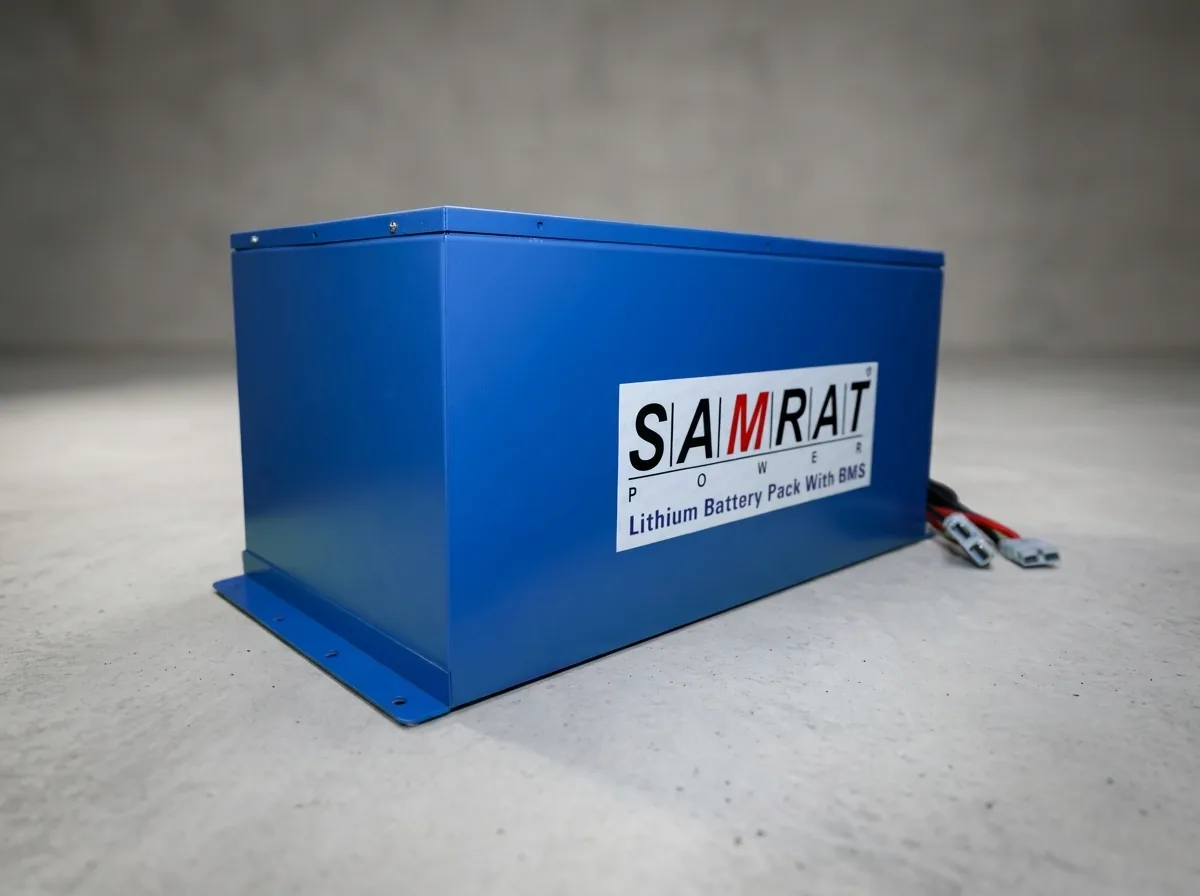
Storage banks built to your site
LFP banks for depot storage and peak shaving, built to your voltage, capacity and enclosure, with a documented BMS. Made and tested in New Delhi.
Price on request · 36-month warranty
One thing that changes the whole calculation
If your depot suffers grid outages, the arithmetic above understates the case considerably.
A charging operation that loses power for four hours loses those vehicle-hours entirely — the packs are not charged, the shift starts short, and no amount of catching up later recovers the trips. Solar with storage keeps charging running through an outage. That is not an energy saving; it is avoided downtime, and for a commercial fleet it is usually worth several times the electricity cost. Where supply is unreliable, size the storage for continuity rather than for arbitrage and the payback looks quite different.
Where to start
Before approaching an installer, establish four things. Your daily charging demand in kWh, which is vehicles multiplied by roughly 5–6 kWh. What proportion of charging could realistically happen in daylight if you rearranged shifts. Your usable roof area. And your current commercial tariff, including any demand charges.
Those four numbers determine array size, whether storage is justified, and what the payback looks like — and they will also tell you quickly whether an installer’s proposal is grounded in your operation or in a template.
If you want the emissions side rather than the money side, we work through what solar charging does to an e-rickshaw’s footprint in how clean is an e-rickshaw really.